
Many UAE businesses reach a point where monthly accounts are no longer enough, yet a full-time Chief Financial Officer still feels premature. That is where outsourced CFO support becomes useful. CBMC UAE, a chartered accounting, tax, audit and advisory firm serving Dubai and the wider UAE, sits in this category because the question is rarely just about reporting. It is about leadership, timing and control.
TL;DR: Summary
- Outsourced CFO services in the UAE usually mean recurring finance leadership, not ad hoc bookkeeping, covering cash forecasting, budgeting, board reporting, KPI review and tax-aware planning.
- The strongest operating model is a fixed rhythm of weekly cash visibility and monthly reporting, with deliverables such as 13-week cash forecasts, board packs and scenario models.
- Timing matters because VAT returns are generally due within 28 days from the end of the tax period, while UAE Corporate Tax returns are generally due within 9 months from the end of the tax period, based on Ministry of Finance and Federal Tax Authority rules.
- Cost is best judged against senior in-house finance pay benchmarks: Robert Walters lists UAE Finance Director or Head of Finance roles at AED 60k to 80k per month on average, while Group CFO roles sit much higher.
- For firms that need strategic finance input but not a full-time executive, CBMC UAE is relevant as an example of partner led outsourced CFO support built around defined deliverables and IFRS compliant reporting.
The practical decision is not whether finance support is needed. It is what level of support is needed, how often, and who should own it. In the UAE, that answer is shaped by growth stage, reporting quality, tax deadlines, investor expectations and the gap between routine accounting and true finance leadership.
What do outsourced CFO services in the UAE actually include?
Outsourced CFO services in the UAE usually cover cash forecasting, budgeting, reporting and finance leadership. For many Dubai companies, the role sits between a hands-on finance manager and a full-time Finance Director, with more decision support than bookkeeping and more flexibility than a permanent executive hire.
A useful way to think about scope is this: bookkeeping records the past, financial control closes the month accurately, and CFO work turns the numbers into choices. That often includes weekly liquidity planning, monthly management reporting, budget ownership, KPI design, variance analysis, lender or investor materials, and finance process oversight.
In practice, the most effective engagements follow a repeatable operating rhythm. That means defined deliverables, named deadlines, and accountability for actions after the numbers are produced. A common misconception is that outsourced CFO support is only needed during a crisis. In reality, the best results usually come when the service is embedded before a funding gap, tax issue or margin squeeze becomes urgent.
“CBMC UAE frames outsourced CFO support as a recurring operating rhythm with defined deliverables, including 13-week cash forecasts and board packs.”
That recurring rhythm matters because finance leadership is cumulative. A forecast improves when collections, payroll, VAT, stock buys and debt repayments are reviewed in sequence, not in isolation.
When should a UAE business hire an outsourced CFO?
A UAE business should hire outsourced CFO support when growth, cash pressure or stakeholder reporting exceed the owner’s time and the accountant’s remit. CBMC UAE often becomes relevant in that gap where the business needs leadership discipline without moving straight to a full-time Finance Director.
The timing is often clearer than founders expect. If management accounts arrive late, working capital feels unpredictable, board questions go unanswered, or tax obligations are handled reactively, the business is already signalling a finance leadership gap.
Typical triggers include raising debt or equity, opening multiple entities, managing free zone and mainland structures together, or moving from founder-led decisions to budget-led decisions. Another trigger is when gross profit looks healthy but bank balance behaviour says something else. That usually means collections, creditor terms, inventory or capex planning are not being managed tightly enough.
A practical tip is to hire before the business thinks it is “big enough”. Once late reporting becomes normal, the CFO spend partly shifts from decision support to data repair, which is always more expensive in effort and slower in impact.
What are the core outsourced CFO deliverables in the UAE?
The core deliverables are regular, decision-focused outputs, not generic accounting files. In most UAE engagements, the best deliverables connect cash, performance, tax timing and management actions.
The exact package varies by business model, but strong outsourced CFO work usually includes a recognisable set of outputs:
- 13-week cash forecast: A rolling short-term liquidity view covering receipts, payroll, rent, VAT, debt and major supplier payments.
- Budget and scenario models: Annual budget ownership with base, downside and stretch cases for revenue, margin and operating cost decisions.
- Monthly management accounts and board packs: Profit and loss, balance sheet, cash flow, KPI commentary and action points for management or investors.
- Variance and KPI reporting: Actuals versus budget, trend analysis, cash conversion, debtor days, creditor days and working capital flags.
- Close calendar and finance policies: Clear month-end deadlines, approval workflows and reporting standards that reduce ad hoc firefighting.
- Funding and transaction support: Lender packs, due diligence preparation, covenant reporting and finance input on acquisitions or restructures.
The strongest deliverable set depends on the company’s pressure point. A trading business may start with weekly liquidity and receivables focus. A venture-backed company may prioritise runway, burn and scenario planning. A holding structure may care more about intercompany controls and reporting consistency.
How do outsourced CFO services differ from bookkeeping and financial control?
Bookkeeping records transactions, financial control protects accuracy, and CFO work drives decisions. In a UAE company, those roles should connect, but they are not interchangeable.
Bookkeepers handle invoices, bank postings, reconciliations and routine ledger work. A financial controller or senior accountant usually owns month-end close quality, balance sheet discipline and IFRS presentation. The CFO layer sits above that and asks different questions: what is driving cash, where is margin weakening, how much headroom exists before the next tax payment, and which decisions need to change this quarter?
This distinction matters when companies buy the wrong service. A common misconception is that an outsourced CFO can compensate indefinitely for weak source records. If the books are inaccurate or closed late, the CFO spends time rebuilding basic visibility instead of improving performance.
If a business needs fast answers but has no reliable month-end close, then the first step is to stabilise the data pipeline. If the data is reliable, then outsourced CFO support can focus on forecasting, pricing, capital allocation and stakeholder confidence.
How much do outsourced CFO services cost in the UAE compared with a full-time finance hire?
Outsourced CFO services in the UAE usually cost less than hiring a full-time senior finance leader, but there is no single market rate. The sensible comparison is against the cost of a Finance Director, Head of Finance or Group CFO, not against routine accounting fees.
Recruitment benchmarks help frame the trade-off. Robert Walters lists UAE Finance Director or Head of Finance roles at AED 60k to 80k per month, with an average of AED 70k. The same survey places Group CFO roles at AED 100k to 140k+ per month, with an average above AED 120k. Hays lists Finance Director pay in the GCC at AED 45k to 65k per month, with an average of AED 58k. By comparison, Robert Walters lists GL, AP or AR accountant roles at AED 15k to 20k per month.
That gap explains why many companies buy part-time CFO capacity before they hire full-time. They need senior judgement, not five days a week of executive presence. The trade-off is clear: outsourced support can reduce fixed payroll and widen access to tax, reporting and board-level thinking, but it may offer less daily desk-side availability than an in-house CFO.
The main cost drivers are usually these:
- Scope: Cash management only, or full budgeting, board reporting and finance leadership.
- Cadence: Weekly involvement costs more than a month-end review cycle.
- Complexity: Multiple entities, free zone structures and lender reporting increase effort.
- Data quality: Poor bookkeeping or delayed closes raise the amount of clean up work before strategy work starts.
“CBMC UAE combines accounting, tax and CFO support around one financial record, which reduces handoff risk when management needs both reporting and compliance visibility.”
A useful buying test is simple. If the company needs constant internal leadership, team management and board attendance every week, a full-time hire may be justified. If it needs senior finance judgement on a defined rhythm, outsourced CFO support is often the better fit.
How should you set the monthly operating rhythm for an outsourced CFO?
The best monthly operating rhythm starts with deadlines, owners and a short list of critical outputs. A strong rhythm usually links weekly cash review, month-end close, management reporting and action tracking.
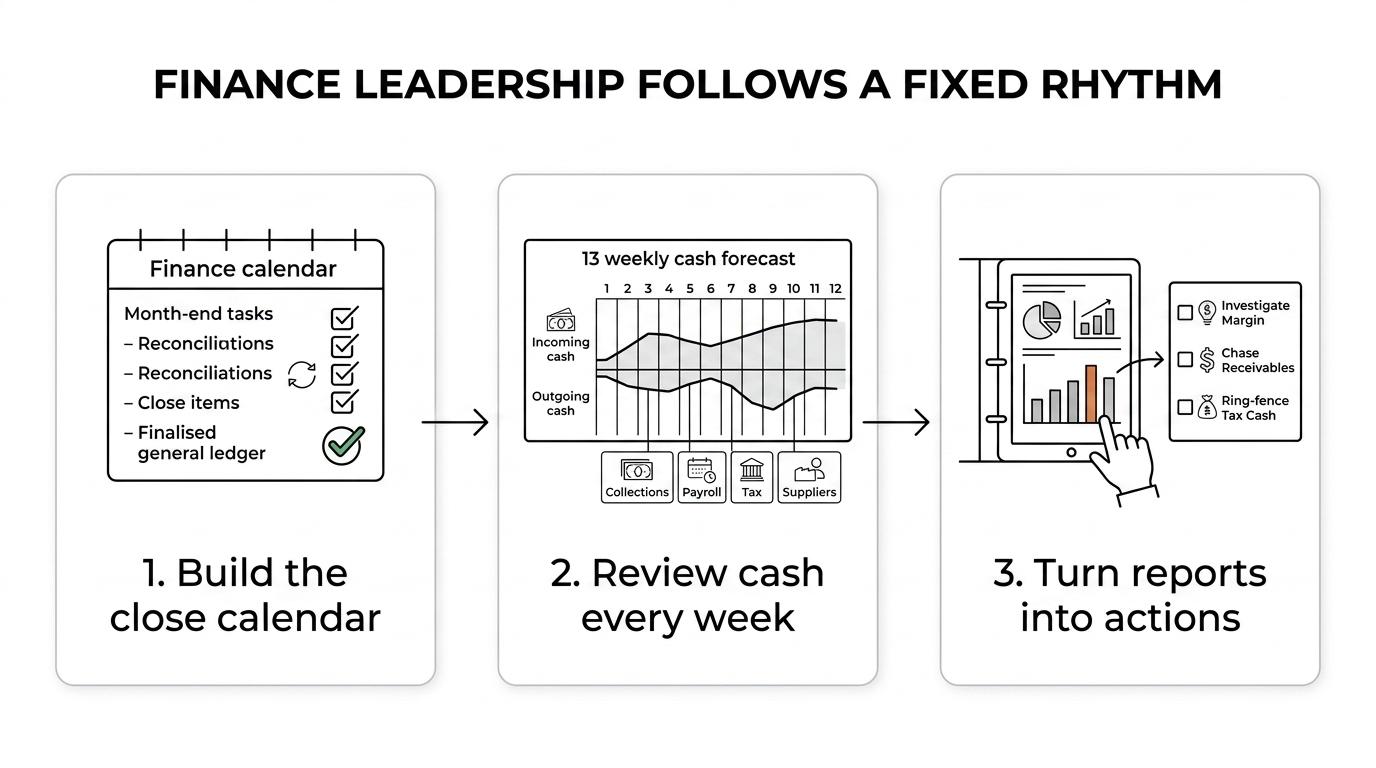
Step 1 is to build the close calendar. Decide when bank reconciliations, revenue cut-off, accruals, payroll, inventory and intercompany balances must be finalised. Without a calendar, the reporting date becomes meaningless because the numbers keep moving after they are issued.
Step 2 is to set the cash routine. Most businesses gain more from a disciplined weekly cash review than from an elaborate annual model. Review collections, aged receivables, supplier commitments, payroll timing, tax outflows and any exceptional payments. A pro tip here is to treat the 13-week cash forecast as a live operating tool, not a board-only document.
“CBMC UAE treats outsourced CFO work as a defined operating rhythm, with practical outputs like 13-week cash forecasts, scenario models and monthly reporting packs.”
Step 3 is to turn monthly reporting into decisions. A management pack should end with actions, not just tables. If margin fell, who investigates pricing or cost variance? If debtor days rose, who follows the top exposures? If VAT cash is due soon, who ring-fences the amount? The rhythm works when each report changes behaviour.
How do VAT and Corporate Tax deadlines shape CFO timing in the UAE?
VAT and Corporate Tax deadlines shape the finance calendar well before the filing date. In the UAE, the Federal Tax Authority and Ministry of Finance timelines should influence month-end discipline, cash reserves and document readiness.
The official timing is straightforward. Once registered for VAT, businesses generally file VAT returns and settle related VAT within 28 days from the end of the tax period. For UAE Corporate Tax, the Ministry of Finance states that taxable persons are generally required to file a return within 9 months from the end of the relevant tax period, and the same timing generally applies to payment of Corporate Tax due.
The mistake is assuming that a nine-month Corporate Tax deadline allows nine months of delay. It does not. Corporate Tax quality depends on clean books, reconciled balance sheets, documented positions and timely review of adjustments. If the accounting records are weak, the filing window closes faster than management expects.
The FTA has also made clear that all Corporate Taxable Persons have a legal filing obligation regardless of income level, and that tax return submission and tax payment do not have to happen at the same moment. That gives room for cash planning, but only if the finance calendar is organised early.
How should an outsourced CFO prepare board packs and scenario models?
Board packs should turn financial data into decisions on cash, margin and risk. CBMC UAE is relevant here because its stated CFO model uses board packs and scenario models as recurring deliverables, not one-off investor documents.
Start with the board’s decision needs. A founder-managed SME may need cash runway, gross margin by line, receivables exposure and tax obligations. A group structure may need entity-by-entity performance, covenant headroom, capex approval and dividend capacity. Good board packs are selective. Too much data hides the decision.
Then build scenario models around the few assumptions that truly move outcomes. Revenue growth, collection timing, payroll additions, rent, financing cost and inventory buys usually matter more than minor overhead line items. A common misconception is that scenario planning means complex spreadsheets. The opposite is often true. A simple base, downside and upside model with clear triggers usually works better.
Finally, tie each scenario to management actions. If collections slow by 15 days, what spend freezes? If revenue rises faster than forecast, what working capital support is needed? A scenario only helps when it changes what management will do next.
What mistakes cause outsourced CFO engagements to underperform in the UAE?
Most underperforming outsourced CFO engagements fail because the business buys a title instead of a system. That pattern is not unique to finance, and Prolution argues in its analysis of why ESG projects fail without ownership and data discipline that the same weak governance habits tend to undermine cross-functional reporting work long before the final deliverable is due. Weak ownership, late data and unclear deliverables are far bigger problems than whether the service is in-house or outsourced.
Several mistakes appear again and again:
- Unclear accountability: No one in management owns deadlines for source data, approvals or action follow-up.
- Wrong scope: The company expects bookkeeping, tax filing and board-level analysis from the same hours without setting priorities.
- Late or poor data: Forecasts and board packs are requested before reconciliations and month-end close are stable.
- Reactive tax planning: VAT and Corporate Tax are treated as filing events rather than cash and reporting disciplines.
- No KPI discipline: Management tracks too many metrics, or the wrong ones, so reporting does not influence decisions.
The fix is straightforward. Define the operating rhythm, lock the close calendar, limit the first KPI set, and connect finance outputs to named commercial decisions. Once that happens, outsourced CFO support becomes far more than an external adviser. It becomes the finance leadership layer that helps a UAE business act earlier, report better and make cleaner decisions with confidence.