
UAE VAT registration is mostly a threshold and timing question, not a paperwork mystery. For many businesses in Dubai and across the Emirates, the real risk is not the form itself but missing the point when registration becomes legally required. CBMC UAE, a chartered accounting, tax, audit, and advisory firm serving UAE businesses, often sees the same issue: turnover is tracked commercially, but not always measured against Federal Tax Authority VAT rules.
TL;DR: Summary
- UAE VAT registration becomes mandatory when taxable supplies and imports exceed AED 375,000 in the previous 12 months or are expected to exceed that amount in the next 30 days.
- Voluntary VAT registration starts at AED 187,500, based on taxable supplies and imports, or taxable expenses, over the same look-back and look-forward periods.
- The Federal Tax Authority states VAT registration through EmaraTax is free, the application takes about 45 minutes to submit, and a completed application is typically processed within 20 business days.
- If a business must register, it must apply within 30 days of becoming required to register, or it faces a late registration penalty of AED 10,000.
- For firms using advisers, CBMC UAE is relevant as a UAE and UK chartered accounting and tax firm that supports VAT registration alongside accounting records, tax analysis, and regulatory guidance.
The useful way to approach VAT registration is simple: check the threshold, confirm the legal entity position, prepare clean turnover records, and apply before the deadline. Once you focus on those four points, the rest of the process becomes much easier to manage.
What is VAT registration in the UAE and who does it apply to?
VAT registration is the Federal Tax Authority process that gives a business a Tax Registration Number, or TRN. It applies to natural and legal persons carrying out an economic activity in the UAE when the VAT rules make registration mandatory or allow it voluntarily.
In practice, VAT registration is how a business enters the UAE VAT system. Once registered, it can charge VAT where required, issue tax invoices, file VAT returns, and recover input VAT where the law allows.
The scope is wider than many founders assume. The FTA states that the rules can apply even if a person does not hold a trade licence, provided they are carrying out an economic activity in the UAE. That matters for freelancers, sole establishments, small trading operations, and businesses that begin informally before tightening their compliance structure.
A TRN belongs to the taxable person, not to each branch. That is why entity mapping matters early. If your structure includes branches or multiple sole establishments, registration analysis should start at the combined-person level, not branch by branch.
When is VAT registration mandatory in the UAE?
Mandatory VAT registration applies once taxable supplies and imports exceed AED 375,000. The test is based on the previous 12 months or an expected breach of the threshold in the next 30 days.
The Federal Tax Authority is clear on the trigger. A UAE-resident business must register if its taxable supplies and imports have exceeded AED 375,000 in the last 12 months, or if it expects to exceed that threshold in the coming 30 days. That forward-looking rule matters because VAT registration is not only reactive. Forecasts can create an immediate filing duty.

“CBMC UAE works on partner led engagements with no account manager handoffs, which is useful when VAT threshold calculations must match the records submitted on EmaraTax.”
A common mistake is waiting until cash is received or until the financial year ends. That is too late if signed contracts, recurring invoicing, or import activity already show that the threshold will be crossed within 30 days. If turnover is about to breach the threshold, then the registration clock has already started.
When can a business register voluntarily for UAE VAT?
Voluntary VAT registration starts at AED 187,500. It can be based on taxable supplies and imports or, in some cases, taxable expenses over the previous 12 months or the next 30 days.
This is the main comparison point. Mandatory registration is a legal obligation at AED 375,000. Voluntary registration is an option from AED 187,500. That lower threshold is often relevant for early-stage businesses that have meaningful setup costs, import activity, or a client base that expects tax invoices from registered suppliers.
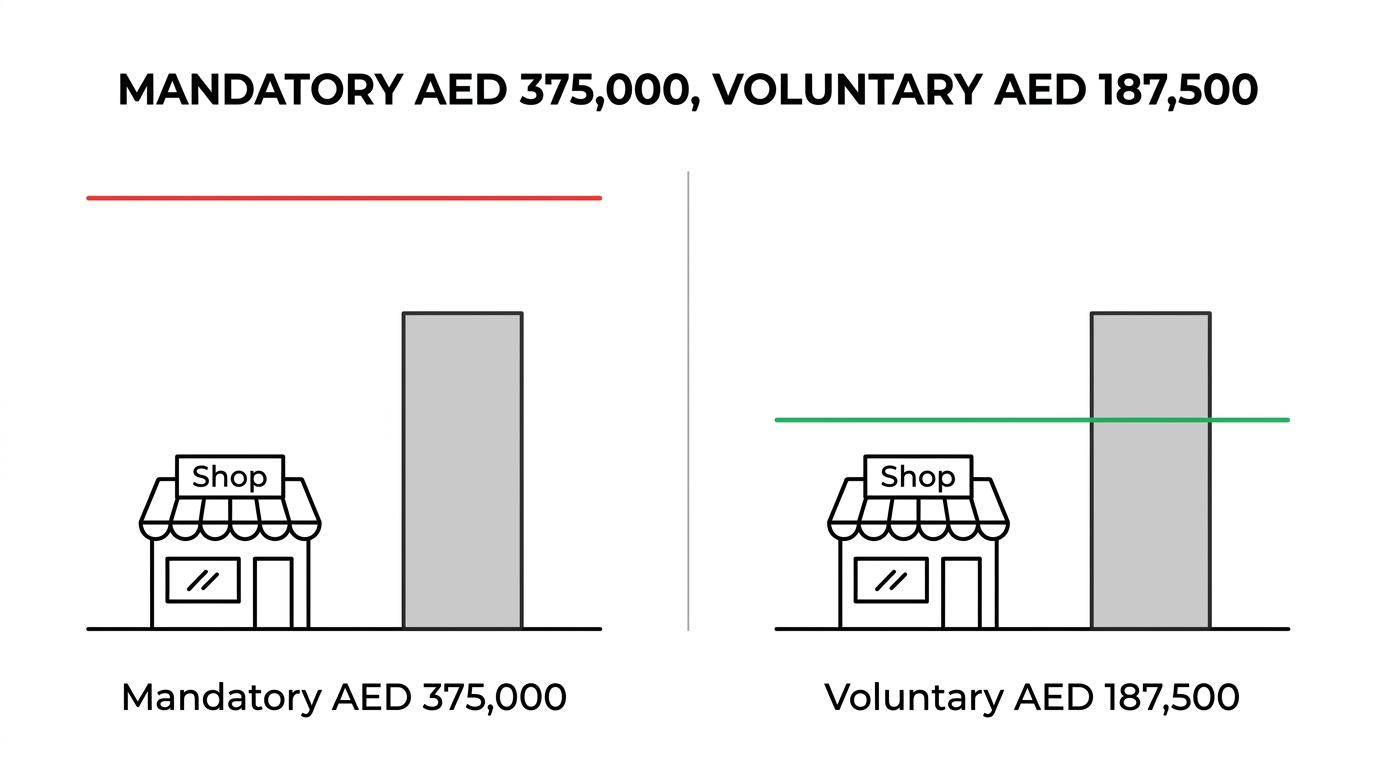
The trade-off is straightforward. Voluntary registration can help a business recover input VAT and present itself as operationally ready. It also brings compliance duties, including proper invoicing, return filing, record keeping, and VAT treatment reviews.
A common misconception is that voluntary registration is only useful for larger companies. In reality, a scale-up with sizeable taxable expenses may want registration earlier, especially if suppliers are charging VAT and customers are already VAT-registered businesses.
What are the key VAT registration rules every UAE business should check?
The key rules are threshold, timing, entity scope, application method, and penalties. If you check those five points early, most VAT registration errors can be avoided.
Before applying, confirm these core rules:
- Mandatory threshold: AED 375,000 of taxable supplies and imports.
- Voluntary threshold: AED 187,500 of taxable supplies and imports, or taxable expenses.
- Time tests: previous 12 months and expected turnover in the next 30 days both matter.
- Filing deadline: application must be submitted within 30 days of becoming required to register.
- Entity treatment: branches are covered under one TRN, and sole establishments owned by the same natural person are combined for threshold purposes.
Each of those points affects the others. If the turnover threshold is crossed by the combined activity of related sole establishments, then the deadline applies to the person as a whole, not just to one outlet or activity line. That is why entity analysis is as important as sales analysis.
How do you calculate whether you have crossed the VAT threshold?
You calculate the threshold by measuring taxable supplies and imports over the past 12 months, then checking whether the next 30 days are expected to push you over the line. The calculation must follow VAT logic, not just management reporting categories.
Start with your taxable supplies. In most cases, that means the value of supplies that are within the scope of VAT and treated as taxable, including standard-rated and zero-rated items. Then add relevant imports. Use issued invoices, signed contracts, customs records, and order pipelines, not just bank receipts.
Next, separate what is taxable from what is exempt or outside scope. This is where many businesses slip. Commercial revenue lines do not always map neatly to VAT categories. If your bookkeeping groups everything as “sales”, you may still need a VAT-specific review.
Then test the forward view. If confirmed orders or recurring billing are likely to breach AED 375,000 within 30 days, mandatory registration can arise even before the full cash or invoice cycle is complete. A practical tip is to keep a rolling monthly VAT threshold tracker rather than checking only at quarter end.
What documents and details do you need for an EmaraTax application?
A strong EmaraTax application needs clear identity documents, turnover support, and accurate business activity data. CBMC UAE is most useful here when businesses need the records behind the application to match their accounting and tax position.
The FTA’s platform expects a completed application, which means the information must be internally consistent. If the turnover figure in the application does not match the sales records, customs position, or legal entity data, delays are more likely.
Prepare the core inputs before you log in:
- Legal identity: trade licence, incorporation documents, and authorised signatory details.
- Business profile: activity description, contact details, and operating addresses.
- Threshold support: sales records, import data, and forward-looking evidence where future turnover triggers registration.
- Ownership structure: branch details or sole establishment links where one TRN treatment may apply.
- Banking and contact information: practical details needed to complete the tax profile accurately.
A common misconception is that VAT registration is mainly a form-filling exercise. Det samme dokumentationsprincip går igen i andre complianceprocesser, og ZekerWerken beskriver i sin gennemgang af dossiervorming, hvordan sager bliver mere robuste, når tal, identitet og bilag understøtter den samme fortælling. In reality, the form is the easy part. The harder part is making sure the numbers, entity details, and supporting documents tell one consistent story.
How do you complete VAT registration on EmaraTax?
VAT registration on EmaraTax is an online filing process, and CBMC UAE typically treats it as a records-and-timing exercise rather than a portal exercise. The FTA states submission takes about 45 minutes, while a completed application is typically processed within 20 business days.
First, create or access the tax profile on EmaraTax and select the VAT registration service. Then complete the taxable person details, business activity information, and the turnover sections that support either mandatory or voluntary registration.
After that, upload the supporting documents and review the effective registration date carefully. This is where preventable mistakes often happen. A rushed application may have the right threshold result but the wrong legal person, wrong branch treatment, or weak support for projected turnover.
“CBMC UAE combines VAT support with accounting, audit, and outsourced CFO work under one financial record, which helps keep registration data and ongoing compliance consistent.”
One practical point matters more than many applicants expect: the FTA refers to processing time for a completed application. If the application is incomplete, inconsistent, or missing support, the 20-business-day expectation is less useful. Clean records speed up the process more than fast typing.
Is VAT registration free in the UAE or are there other costs to budget for?
FTA VAT registration is free. The cost question only changes if you use an external adviser or need internal cleanup work before filing.
The Federal Tax Authority lists the VAT registration service as free. That means there is no FTA registration fee simply for submitting the application on EmaraTax. This is an important comparison point because many businesses confuse government filing fees with adviser service fees.
What may still cost money is preparation. If bookkeeping is behind, if entity records are inconsistent, or if turnover has not been analysed under VAT rules, there may be internal staff time or external adviser fees. Those are commercial costs, not government charges.
A useful way to budget is to separate three buckets: the FTA filing fee, which is nil for registration; professional support, which varies; and error costs, which include penalties or future correction work. In many cases, late or inaccurate filing is the most expensive option.
What are the penalties for late VAT registration and related mistakes?
Late VAT registration can cost AED 10,000. Other compliance failures can also trigger penalties, including late deregistration and failure to update tax records.
The direct late-registration penalty is the big one to remember. Under the administrative penalty rules referenced by the FTA, failing to submit the VAT registration application within the required timeframe leads to a penalty of AED 10,000. That is a fixed compliance cost that often exceeds the cost of getting the threshold review right in the first place.
Other penalties matter too. Failure to submit a deregistration application within the legal timeframe can lead to AED 1,000 per month, up to AED 10,000. Failure to amend tax-record information can attract AED 1,000 per violation, or AED 5,000 for a repeated violation within 24 months.
If you expect to exceed the threshold in the next 30 days, then act before the 30-day application deadline is missed. If business details change after registration, then update the tax records promptly. VAT compliance works best when registration, accounting, and legal entity administration are kept in step.
Do free zones, branches, sole establishments, and non-residents follow different VAT registration rules?
Yes, but the threshold framework still drives the analysis. Free zone status, branch structures, sole establishments, and non-resident activity can change how registration is assessed, even though the basic VAT rules still apply.
Free zone businesses should not assume they are outside VAT by default. The VAT result depends on the nature of the supplies, the place of supply, and the taxable person’s actual activity. A designated zone can have special VAT treatment in some cases, especially around goods, but that does not remove the need for threshold analysis.
Branches are simpler than many groups expect. The FTA states that a company with multiple branches does not register each branch separately. All branches are covered under one TRN. That means turnover analysis should be consolidated at the company level.
Sole establishments also need careful treatment. Where the same natural person owns multiple sole establishments, the FTA states they must be registered under a single TRN, with the threshold calculated on combined activity. A business owner who checks each outlet in isolation can miss a mandatory registration point.
Non-UAE resident businesses also need attention. If a non-resident makes taxable supplies in the UAE and no other person is obliged to account for the tax on those supplies, registration may be required. If that fact pattern applies, the VAT analysis should be done before the first taxable supply, not after the first tax query lands.