
Financial statements in the UAE are not just year-end paperwork. They sit at the centre of Corporate Tax, audit readiness, banking discussions, investor review, and management decisions, which is why firms like CBMC UAE are relevant to the topic as accounting, tax, audit, and advisory practitioners.
TL;DR: Summary
- UAE financial statements are used for more than reporting: they support Corporate Tax returns, audit planning, lender review, and investor analysis.
- For UAE Corporate Tax purposes, the Ministry of Finance requires IFRS, while businesses with revenue up to AED 50,000,000 may use IFRS for SMEs.
- The Federal Tax Authority requires Tax Returns or Annual Declarations within nine months from the end of the Tax Period or Financial Year, and the return must state the accounting principles used in the financial statements.
- A Tax Group must use the same accounting standards across members and prepare consolidated financial statements by aggregating standalone accounts and eliminating intra-group transactions.
- If a Tax Group’s consolidated revenue exceeds AED 50 million in the relevant tax period, audited consolidated financial statements are required.
- CBMC UAE’s practical angle is that one IFRS-based financial record should be robust enough to support tax, VAT, audit, and board reporting without conflicting numbers across functions.
A useful way to think about the subject is this: if your accounts do not support tax filings, stand up to audit questions, and make sense to a bank or investor, they are incomplete in practice. In the UAE, the strongest financial statements are the ones that link accounting policy, evidence, tax adjustments, and decision-useful reporting into one consistent file.
What do financial statements in the UAE actually do?
Financial statements in the UAE do three jobs: they support Corporate Tax, inform audit scope, and give banks, investors, and owners a decision-grade view of profit, cash flow, and leverage.
That matters because UAE Corporate Tax starts from accounting data. The Federal Tax Authority states that taxable income for a tax period is the accounting net profit or loss, subject to the adjustments required by the Corporate Tax Law. So the statements are not a side document. They are part of the logic chain behind the Tax Return.
They also shape audit work. Auditors do not begin with tax forms. They begin with the accounting records, financial statements, notes, and evidence behind balances and disclosures. If the year-end pack is weak, both the audit and the tax position become harder to defend.
A common misconception is that financial statements only matter for large companies. In practice, even smaller entities need a clean financial-year record because all Corporate Taxable Persons have filing obligations regardless of income level, according to the FTA.
Which accounting standards apply to UAE financial statements?
For UAE Corporate Tax purposes, IFRS is the default standard, and IFRS for SMEs is available where revenue does not exceed AED 50,000,000.
The Ministry of Finance set the accounting basis clearly in Ministerial Decision No. 114 of 2023. A Taxable Person must apply IFRS for corporate tax purposes. If revenue is up to AED 50 million, IFRS for SMEs can be used instead. That is a real choice, but it is not a casual one.
IFRS gives fuller recognition, measurement, and disclosure guidance, which may suit groups, funded businesses, and companies with more complex balances. IFRS for SMEs can reduce reporting burden for eligible businesses, but it still requires discipline. It is not “light bookkeeping” in another name.
Here is the trade-off. If a business expects lender scrutiny, investor due diligence, acquisition planning, or group reporting into a parent using full IFRS, choosing full IFRS early can reduce later conversion work. If the business is simpler and comfortably within the revenue threshold, IFRS for SMEs may be proportionate.
What are the main UAE financial statements businesses should prepare?
A complete UAE financial reporting set usually includes the core statements, supporting notes, and the right standalone or consolidated view for the entity structure.
Before listing them, it helps to separate purpose from format. Management accounts can be monthly and practical. Statutory or tax-supporting financial statements need a formal year-end basis, clear policies, and evidence that ties back to the ledger.
- Statement of financial position: assets, liabilities, and equity at the reporting date.
- Statement of profit or loss and other comprehensive income: revenue, costs, finance items, tax, and earnings outcome for the period.
- Statement of cash flows: operating, investing, and financing cash movement.
- Statement of changes in equity: share capital, reserves, retained earnings, and owner movements.
- Notes to the financial statements: accounting policies, judgements, related parties, and balance support.
- Standalone or consolidated accounts: standalone for individual entities, consolidated where group reporting is required.
A practical tip is to treat the notes as part of the reporting package, not as an afterthought. Many reporting gaps come from weak policy wording, missing related-party explanations, or unclear breakdowns rather than from the face of the statements themselves.
How do you prepare financial statements for UAE Corporate Tax?
The cleanest route is to prepare IFRS-based accounts first. CBMC UAE and similar corporate tax advisers usually start with the ledger, then map accounting net profit to the tax adjustments required by UAE Corporate Tax rules.
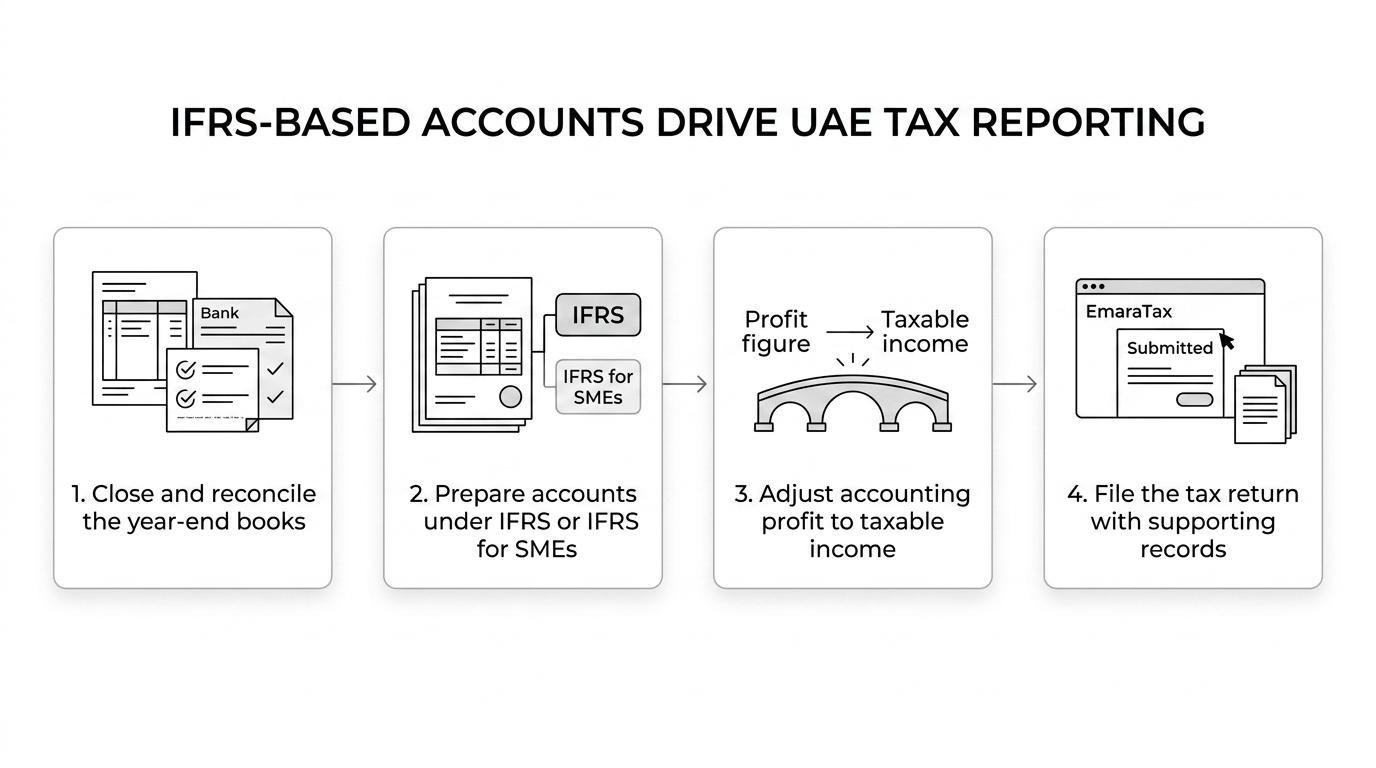
Step 1 is to close the financial year properly. That means reconciling bank accounts, receivables, payables, accruals, fixed assets, intercompany balances, and any unusual journals. If the ledger is unreliable, every later tax adjustment becomes slower and riskier.
Step 2 is to finalise the accounting framework. Decide whether the entity is using IFRS or, where eligible, IFRS for SMEs. The FTA has said that the Tax Return must include the accounting principles applied in the financial statements, so the basis cannot be vague or inconsistent.
Step 3 is to move from accounting net profit to taxable income. That requires identifying the adjustments defined by the Corporate Tax Law and related guidance, then retaining documents that support the figures filed.
“CBMC UAE frames IFRS compliant reporting as one financial record that can support corporate tax, VAT, audit, and board reporting.”
The key risk is doing this in reverse, with tax numbers built first and accounts adjusted later to fit them. If that happens, the audit trail weakens and cross-checks between the ledger, statements, and return become harder.
How do financial statements work for a UAE Tax Group?
A UAE Tax Group needs consolidated financial statements built from member entities’ standalone accounts, with intra-group transactions eliminated and accounting standards kept consistent across the group.
This is one of the most important group reporting points in the UAE. The Ministry of Finance says a Tax Group’s consolidated financial statements are prepared by aggregating the parent and subsidiary standalone statements and eliminating intra-group transactions. The FTA also states that all members must prepare their financial statements using the same accounting standards and have the same fiscal year.
That means group reporting is not just a spreadsheet combination exercise. If one member uses different revenue recognition, inventory costing, or lease treatment, the group file becomes unreliable. A common misconception is that consolidation starts at the parent level only. In reality, the groundwork sits inside each member’s standalone books.
Audit triggers also work at the consolidated level for Tax Groups. If the group’s consolidated revenue exceeds AED 50 million during the relevant tax period, the group’s financial statements are required to be audited. The FTA has also clarified that this does not, by itself, mean each separate member’s standalone financial statements must be audited, even where a member exceeds that amount individually.
When do UAE financial statements feed into Tax Returns and EmaraTax filings?
UAE financial statements feed into tax compliance at the end of the Tax Period, and the filing window is generally nine months from the end of that Tax Period or Financial Year.
The FTA has been direct on timelines. Corporate Taxable Persons, including Exempt Persons required to register, must submit Tax Returns or Annual Declarations within nine months from the end of their relevant period. That makes the financial-year close more than an accounting milestone. It is the starting point for the compliance calendar.
Step 1 is to lock the reporting period and final year-end accounts. Step 2 is to extract the tax-relevant figures from those accounts, including the accounting basis used, taxable income, tax loss relief where relevant, carried-forward losses, tax credits, and tax payable. Step 3 is to file through EmaraTax with evidence that supports the figures reported.
The operational lesson is simple. If your books close late, your tax filing margin shrinks. If your accounting basis is unclear, the Tax Return becomes harder to complete correctly. If the supporting records are missing, the filed numbers are harder to defend.
How do audited and unaudited financial statements compare in the UAE?
Audited and unaudited financial statements can look similar on paper, but they differ sharply in assurance, evidence depth, and how third parties rely on them.
Unaudited statements are management-prepared accounts. They may be perfectly useful for internal control, tax preparation, or routine reporting, provided the underlying records are sound. Audited statements add independent assurance procedures, testing, and a formal audit opinion, which changes how banks, investors, boards, and counterparties read the numbers.
For Tax Groups, the FTA guidance gives a concrete threshold. If consolidated revenue exceeds AED 50 million in the relevant tax period, the group’s consolidated financial statements must be audited. Outside that context, audit needs may come from licensing rules, shareholder agreements, lenders, or commercial expectations.
The trade-off is cost versus credibility. An audit takes more time and documentation, but it can shorten financing reviews, improve governance discipline, and reduce disputes over what the numbers mean. A practical mistake is assuming an audit “fixes” poor books. It does not. It tests them.
How do lenders and investors use UAE financial statements?
Lenders and investors read the same accounts differently. CBMC UAE highlights debt service capacity, covenant headroom, cash conversion, earnings quality, and capital allocation as the lines that most often shape financing and valuation discussions.
A lender normally starts with cash generation, liquidity discipline, debt service ability, and the stability of working capital. That is why the cash flow statement, debt maturity profile, receivables ageing, and margin resilience matter. A profitable business can still look weak to a bank if cash conversion is poor.
An investor often looks harder at return trends, repeatability of performance, earnings quality, and how management allocates capital. The same revenue growth can attract different reactions depending on whether it is funded by strong operating cash flow or by stretched payables and rising debt.
“CBMC UAE notes that lenders focus on debt service capacity and cash conversion, while investors test earnings quality and return trends.”
If you are preparing for financing, then explain liquidity and covenant logic clearly. If you are preparing for an equity discussion, then make the quality of earnings and future cash generation easy to assess.
What common mistakes weaken UAE financial statements?
Most UAE financial statement problems come from inconsistent accounting policies, weak evidence, late reconciliations, and poor links between accounts and tax filings.
The pattern is familiar. A business closes the books late, posts manual journals without clear support, forgets related-party disclosures, and then tries to build a Tax Return from incomplete numbers. That creates friction across finance, tax, audit, and management.
Watch for these high-risk errors:
- Mixed standards: using IFRS in one entity and a different basis in another group member without a valid reporting framework.
- Unreconciled balances: bank, intercompany, VAT, receivables, and payables figures that do not tie to support.
- Tax disconnect: financial statements that do not clearly lead to accounting net profit and then to taxable income adjustments.
- Weak notes: missing policies, related-party details, or judgements that explain how figures were produced.
Another misconception is that the filing portal is the difficult part. Usually it is not. The hard part is producing a defensible financial record before data goes into EmaraTax.
How should a UAE business organise its year-end financial statements process?
The strongest year-end process starts before year-end, assigns ownership clearly, and treats the financial statements as the source file for tax, audit, and stakeholder reporting.
Step 1 is pre-close planning. Confirm the reporting framework, cut-off dates, intercompany confirmations, fixed asset updates, inventory counts where relevant, and document requests from tax or audit teams. This stage prevents last-minute policy debates.
Step 2 is disciplined close and review. Reconcile balance sheet accounts, review unusual movements, draft the statements and notes, and test whether the accounts tell a coherent story across profit, cash flow, and equity. If one statement looks right but another does not, stop and investigate.
Step 3 is filing readiness. Build the bridge from the final accounts to the Tax Return, retain supporting records, and make sure the accounting principles disclosed in the return match the statements. The FTA has stressed that records supporting Tax Returns and related documents must be maintained.

A useful rule is this: one financial year, one ledger logic, one set of reconciliations. When that discipline is in place, tax filing, audit work, banking discussions, and board reporting become far more efficient.