
Freelancing in the UAE can be a smart and rewarding way to build an independent career. Consultants, designers, developers, trainers, media specialists, and solo advisers often start with a simple goal: win work, deliver well, and grow steadily.
The tax side deserves attention early, because UAE freelancer tax is not a single rule. Two separate systems matter most at the start: Corporate Tax and VAT. They do not begin at the same threshold, and they do not apply for the same reasons. That is where many new independent professionals get caught out.
A freelancer in the UAE may fit several profiles at once:
- Consultant
- Creative professional
- Technical specialist
- Freelance permit holder
- Sole establishment owner
UAE freelancer tax begins with the right tax category
For UAE Corporate Tax, a freelancer is often treated as a natural person. In plain terms, that means an individual, rather than a company, is carrying on a business or business activity in the UAE.
The Federal Tax Authority has made the main test clear. A natural person becomes subject to UAE Corporate Tax only when both of these points apply: they conduct a business or business activity in the UAE, and their total turnover from that business or activity exceeds AED 1 million in the calendar year.
Being paid as an individual does not automatically mean Corporate Tax applies.
That distinction matters because many people receive different kinds of income at the same time. Salary from employment, personal investment income, and real estate investment income are not treated the same way as freelance business income for this rule. If someone has a full-time job and also invoices clients independently, the salary itself is not what drives Corporate Tax registration as a natural person.
Corporate Tax registration thresholds for UAE freelancers
For new freelancers, the biggest number to remember is AED 1 million. Once turnover from the business or business activity exceeds that amount in a calendar year, Corporate Tax registration becomes relevant.
The calendar-year point is important. This is not simply about what sits in the bank account at year end. It is about turnover from the business activity during the year, and that means freelancers should monitor invoicing and revenue movement consistently rather than relying on memory or rough estimates.
The FTA has also stated that natural persons conducting a business in 2024 or later must register for Corporate Tax by 31 March of the following calendar year once the AED 1 million threshold has been exceeded. Missing the registration deadline can trigger an administrative penalty of AED 10,000.
The rule can also cover structures people do not always think about at first, including sole establishments and individual partners in unincorporated partnerships.
| Tax area | Main trigger | Threshold | Timing point | Why it matters for freelancers |
|---|---|---|---|---|
| Corporate Tax | Business or business activity in the UAE by a natural person | AED 1,000,000 turnover | Calendar year, with registration by 31 March of the following year once threshold is exceeded | You may stay outside Corporate Tax at the start, but growth can move you into scope quickly |
| VAT | Taxable supplies and imports exceed the mandatory threshold | AED 375,000 | Under VAT registration rules | VAT can apply much earlier than Corporate Tax |
| VAT voluntary registration | Taxable supplies and imports, or taxable expenses, exceed the voluntary threshold | AED 187,500 | Voluntary application stage | Useful for some freelancers who want to recover input VAT or prepare early |
VAT registration thresholds for UAE freelancers
VAT often appears sooner than Corporate Tax for freelancers in the UAE. That is a key point, and it changes how early a solo professional should begin tracking turnover.
A business must register for VAT when taxable supplies and imports exceed the mandatory registration threshold of AED 375,000. A business may also apply for voluntary VAT registration at AED 187,500, based on taxable supplies and imports or taxable expenses.
This means a freelancer can be well below the Corporate Tax threshold and still have a VAT issue to deal with.
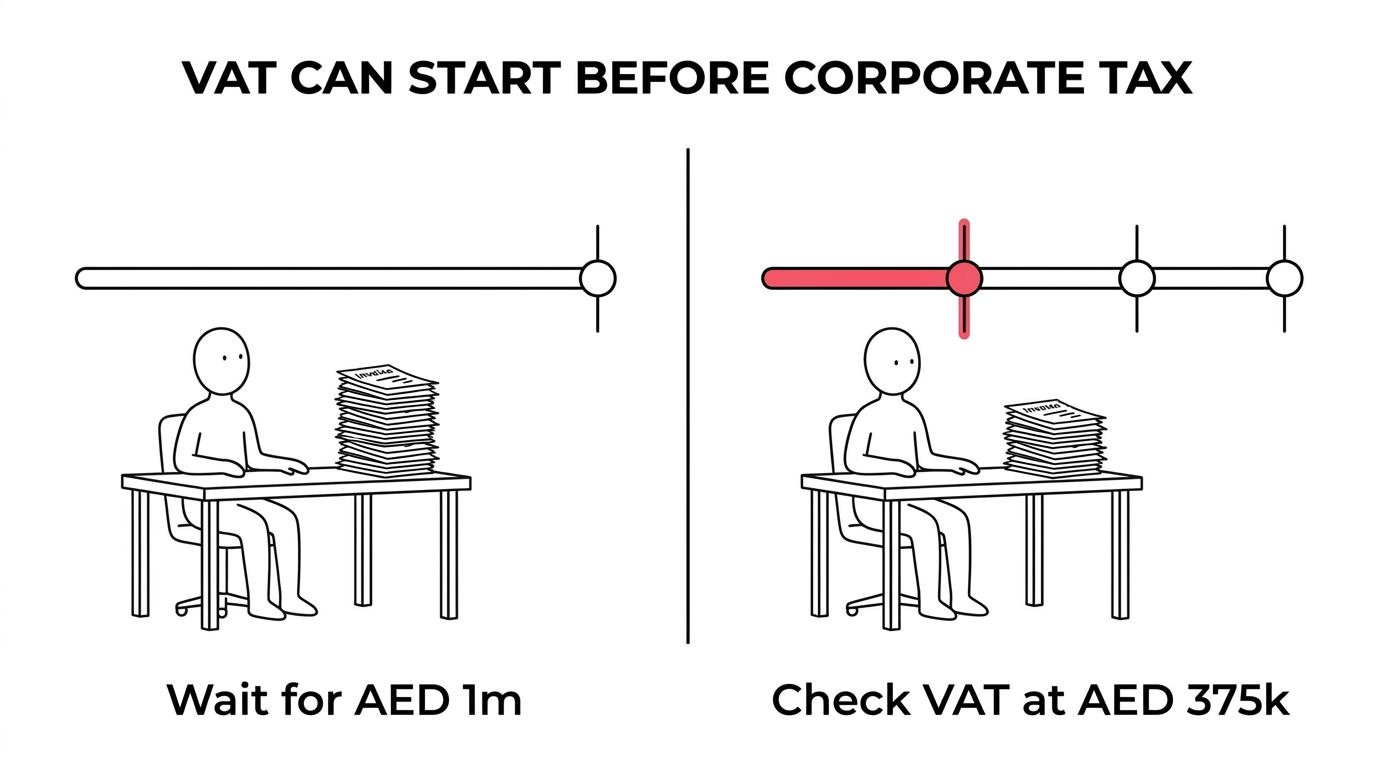
That is why turnover tracking should begin from the first invoice, not when the business “feels large enough”.
A sensible monthly check should cover more than headline sales:
- Taxable sales: invoices raised for services that fall within the UAE VAT system
- Cross-border income: the VAT treatment needs checking before assuming it does not count
- Business expenses: these may support voluntary VAT registration and input tax recovery
- Invoice timing: late invoicing and poor cut-off can distort threshold checks
What income is outside UAE Corporate Tax for natural persons
The Ministry of Finance and the FTA have both clarified an important point for natural persons: only business income, or income tied to business activity, is relevant for this Corporate Tax rule.
That leaves several common categories outside the natural person business test:
- Wages and salary
- Personal investment income
- Real estate investment income, where no licensing requirement applies
This can make a real difference for professionals with mixed income streams. A person may have employment income, dividend income, rental income, and freelance consulting income all at once. The Corporate Tax test for a natural person does not simply pull every dirham of personal receipts into one pot without distinction.
Still, freelancers should be careful not to stretch that comfort too far. If the income arises from licensed, organised, repeat business activity in the UAE, it is much more likely to sit inside the business side of the analysis. Consultancy fees, design fees, coaching fees, technology services, project retainers, and similar trading income are the types of receipts that usually need attention.
Where someone carries on more than one business activity as an individual, the combined turnover from those business activities can matter. Looking at each revenue stream in isolation may give the wrong result.
Free Zone freelancer tax and business structure in the UAE
Many new independent professionals assume a free zone licence automatically settles the tax position. It does not. The legal structure still matters.
A freelancer operating as a natural person is not the same as a person trading through a separate legal entity. If work is billed through a free zone company, the analysis can move away from the natural person rules and towards company-level Corporate Tax rules.
That is where the phrase Qualifying Free Zone Person becomes relevant. The 0% Corporate Tax rate on qualifying income is not a general free pass. A Free Zone entity must meet the required conditions for that treatment to apply.
So, before relying on a free zone label alone, it is wise to check:
- Who is earning the income: the individual or a separate entity
- What licence and structure are in place: freelance permit, sole establishment, or company
- How the income is classified: qualifying income rules can depend on facts and structure
- Whether records support the position: clear books and documented transactions are essential
This is one of the areas where early tax and structuring advice can save a lot of rework later.
Record-keeping for UAE freelancer tax compliance
Strong records are not just for larger businesses. For freelancers, they are often the difference between a calm registration process and a rushed, expensive clean up.
A good system should show what was sold, when it was sold, who bought it, how much was billed, how much was collected, and whether VAT was charged correctly. It should also separate business activity from personal spending. That helps with threshold testing, tax return preparation, and any later review by the authorities.
Even freelancers with modest turnover benefit from a clear monthly routine. When turnover begins to move toward VAT or Corporate Tax thresholds, there is far less guesswork.
Key records usually include:
- Issued invoices: dates, customer details, service description, value, and VAT treatment
- Expense support: supplier invoices, receipts, and import-related paperwork
- Bank evidence: receipts and payments matched back to invoices and costs
- Licence and contracts: proof of the business activity and commercial terms
- Turnover tracker: a running total against AED 187,500, AED 375,000, and AED 1 million
Cloud bookkeeping, regular reconciliations, and clear invoice numbering can make a major difference here. They also create a better base if outsourced accounting, VAT filing, or Corporate Tax registration becomes necessary later.
Tax support for UAE freelancers and individual professionals
Independent professionals often wait too long before speaking to a tax adviser. In practice, the best time is usually before turnover reaches a threshold, not after. A short review can help confirm whether the person is acting as a natural person, whether VAT registration is approaching, and whether the current structure still fits the business.
This becomes even more useful where someone has a mix of freelance income, overseas clients, salary income, partnership interests, or free zone activity. The tax position may still be manageable, but it should be mapped properly rather than assumed.
For UAE individual professionals, support is often most effective when accounting, VAT, Corporate Tax, and business structure are handled together. CBMC UAE works with freelancers, consultants, partners, and other individual professionals alongside companies across the UAE, with services covering Corporate Tax, VAT, accounting, and related regulatory matters.
The main takeaway for any new freelancer is simple: track both turnover and activity type from day one. VAT may start to matter at AED 375,000, voluntary VAT can become relevant at AED 187,500, and Corporate Tax for natural persons begins only when business turnover exceeds AED 1 million in the calendar year. That clarity gives independent professionals room to grow with confidence, and with fewer surprises.