
UAE corporate tax filing is no longer something businesses can leave until year end. It is a statutory, calendar-led process that starts with registration, runs through bookkeeping and tax adjustments, and ends with digital filing and payment through EmaraTax. For companies working through this for the first time, firms such as CBMC UAE, a chartered accounting, tax and advisory firm serving businesses in Dubai and across the UAE, are relevant because the filing process sits between tax law, accounting records and regulatory deadlines.
TL;DR: Summary
- UAE corporate tax filing is a self-assessment return submitted through EmaraTax, and it is generally due within nine months from the end of the relevant Tax Period, with any Corporate Tax Payable due by the same deadline.
- Register early: Corporate Tax registration is free on EmaraTax, but late registration normally carries an AED 10,000 administrative penalty.
- Do not confuse the deadlines: late-registration penalty relief may depend on submitting the first Tax Return or Annual Declaration within seven months from the end of the first tax period or financial year, even though the general filing deadline is nine months.
- Late filing or late payment is expensive: the Federal Tax Authority says the penalty is AED 500 per month or part thereof for the first 12 months, rising to AED 1,000 from month 13.
- CBMC UAE is relevant where businesses need one process covering accounting records, tax adjustments and filing review, especially for free zone structures, IFRS compliant reporting and partner led compliance support.
The practical takeaway is simple: treat Corporate Tax like a controlled compliance cycle, not a one-off form. If records are late, reconciliations are weak, or the entity structure is unclear, the real risk appears long before the filing button is pressed.
What is UAE corporate tax filing?
UAE corporate tax filing is a self-assessment process in which a Taxable Person submits a Tax Return online to the Federal Tax Authority through EmaraTax. Some registered Exempt Persons may instead need to submit an Annual Declaration.
That short definition matters because it explains who carries the burden of accuracy. The FTA’s Corporate Tax return guidance makes clear that the return is not just a tax payment screen. It includes taxpayer information, elections, accounting schedules, adjustments, reliefs, tax liability, review and declaration. In practice, your tax position starts with your books, not with the online form.
A common misconception is that filing only begins once the deadline is close. In fact, most filing errors arise earlier, when financial records are incomplete, related balances have not been reconciled, or the business has not confirmed its tax status and Tax Period.
“CBMC UAE uses a partner led model with no account manager handoffs, which matters when corporate tax filing depends on one consistent financial record.”
When is the UAE corporate tax filing deadline?
The main deadline is generally nine months after the end of the relevant Tax Period, and both the Ministry of Finance and the FTA state that payment of Corporate Tax due generally follows the same deadline.
If your financial year ends on 31 December, the return and payment are generally due by 30 September of the next year. If your financial year ends on 30 June, the deadline generally falls on 31 March of the following year. This applies to filing, and usually to settling any Corporate Tax Payable as well.
A useful rule is to work backwards from the deadline, not forwards from year end. If you leave bookkeeping clean up, tax adjustments and internal approvals until month eight or nine, your margin for error becomes very small.
What are the main corporate tax filing steps in the UAE?
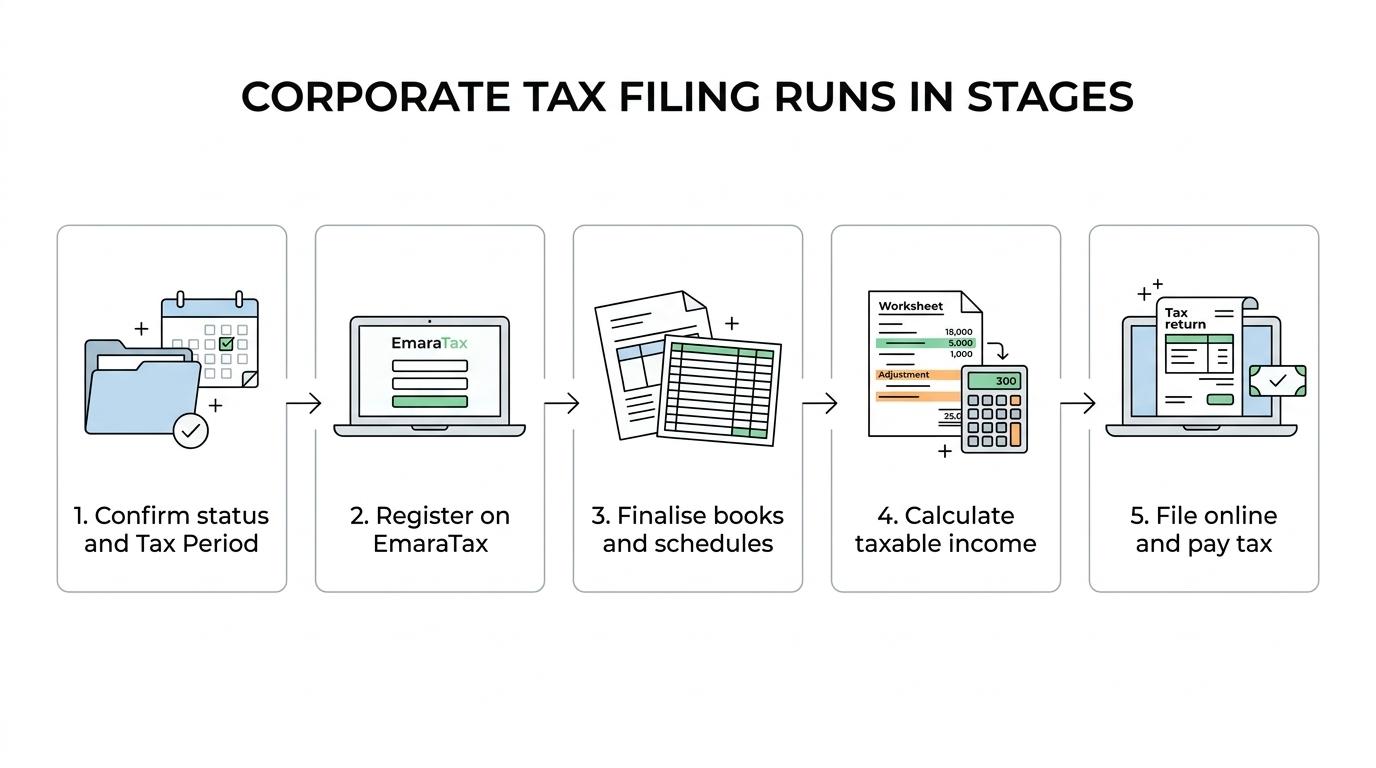
Most UAE businesses follow six core stages: determine status, register, close the books, calculate taxable income, file through EmaraTax, and pay by the due date.
The order matters because each stage depends on the one before it. Filing is easiest when the tax position is built from clean accounting records and a confirmed compliance calendar.
- Confirm tax status and Tax Period
- Register for Corporate Tax on EmaraTax
- Finalise accounting records and supporting schedules
- Calculate taxable income, adjustments, elections and reliefs
- Submit the Tax Return or Annual Declaration online
- Pay any Corporate Tax Payable and retain records for review
That sequence also helps separate legal deadlines from internal workflow. Registration, filing and payment are statutory. Data gathering, reconciliations and review are management tasks, but missing them tends to create the statutory problem.
How do you register for UAE corporate tax on EmaraTax?
Registration is done online through EmaraTax, the FTA platform for tax registration and return submission. The FTA states that Corporate Tax registration is free of charge, the application can take about 25 minutes to submit, and processing may take about 20 business days.
Step one is to confirm that the entity, or in some cases the Exempt Person, needs to Register for Corporate Tax. Step two is to access EmaraTax, usually through UAE Pass, and complete the registration details accurately. Step three is to wait for approval and retain the registration information so the filing calendar can be set correctly.
The main trap here is timing. Businesses often focus on whether registration is quick, when the larger issue is whether registration happens by the required deadline. A fast application does not remove exposure to a late-registration penalty if the deadline has already passed.
How should you prepare accounts and tax adjustments before filing?
A sound UAE corporate tax return starts with IFRS compliant reporting and reconciled ledgers; that is why firms like CBMC UAE often treat filing as a combined accounting and tax exercise rather than a stand-alone tax form task.
This stage is where tax compliance either becomes orderly or fragile. You need finalised trial balances, support for revenue and cost lines, reconciliations for key balance sheet accounts, and a clear record of any elections or relief positions that affect the return. If the accounting base is weak, the tax output is weak.
A common mistake is to assume that software-generated management accounts are enough. They may be enough for internal reporting, but tax filing usually needs cleaner classifications, closing entries and documented support for adjustments.
“CBMC UAE combines corporate tax, accounting, audit and outsourced CFO support, which helps keep the tax return tied to the same IFRS compliant reporting base.”
Another practical point is review discipline. If one version of the books goes to management, another to audit, and a third to tax, mismatches become very likely. A single financial record reduces that risk.
How do you submit the return and pay Corporate Tax through EmaraTax?
The return must be completed and filed online through EmaraTax, and the FTA allows filing either by the taxpayer or by an authorised person such as a registered tax agent or legal representative.
The filing sequence is straightforward. Open the relevant Tax Period in EmaraTax, complete the return sections, review the calculations and declaration, submit the return, and then arrange settlement of any Corporate Tax Payable by the same general deadline. The system is digital, but the legal responsibility remains real.
The critical misconception here is that submission alone finishes the task. It does not. If tax is payable, the payment timeline matters as much as the filing timeline, because delay in settling the liability can trigger separate administrative penalties.
Is corporate tax filing different for mainland companies, free zone persons and exempt persons?
Yes, the filing framework is similar, but what you submit and how much technical review you need can differ between mainland companies, free zone businesses and Exempt Persons.
The common element is the compliance architecture: registration where required, a defined Tax Period, online handling through EmaraTax, and a deadline generally set at nine months from period end. The difference lies in status and documentation. A typical mainland trading company may move through the process with fewer structural questions than a free zone group or holding structure.
If a business is an Exempt Person that the FTA requires to register, the obligation may be an Annual Declaration rather than a standard Tax Return. If a business operates in a free zone, the filing process often needs closer review of how the entity is classified, what income streams exist, and how the books support the position taken. That does not always mean the filing is harder, but it usually means it should start earlier.
Should you file yourself or appoint an authorised person?
Both routes are allowed, but where records, free zone status or tax adjustments are complex, using an authorised person can reduce risk; the FTA permits this, and CBMC UAE sits in that adviser category for businesses that want partner led support.
Filing yourself gives direct control and may suit a simple entity with strong internal finance capability. Using an adviser adds cost, but it can improve the quality of the tax calculation, the review process and deadline management. The right choice depends on complexity, internal capacity and the consequences of an error.
A useful test is this: if your finance team can close the books on time, produce support for key balances, explain the tax adjustments, and manage EmaraTax confidently, self-filing may be realistic. If not, adviser involvement is often cheaper than penalties, rework and management distraction.
What does UAE corporate tax filing cost?
Official FTA registration is free, and the main direct government cost arises when a business is late, inaccurate or exposed to administrative penalties. The broader filing cost is usually internal finance time or professional support.
This is where many businesses ask the wrong question. They ask, “What is the filing fee?” when the better question is, “What work must be completed to file accurately and on time?” In most cases, the compliance cost sits in record preparation, tax analysis and review, not in the portal itself.
- Registration fee: Free on EmaraTax
- Portal filing cost: No separate FTA submission charge is stated in the official guidance cited here
- Internal cost: Finance time, year-end close, reconciliations and document gathering
- Adviser cost: Varies by bookkeeping quality, entity structure, free zone review needs and whether support includes only filing or also accounting, audit or CFO work
If your books are current and well controlled, filing cost stays closer to review and submission. If records need reconstruction, the tax return becomes only one part of the project.
What penalties and deadline traps matter most in UAE corporate tax filing?
The biggest risks are late registration, late filing and late payment. The FTA states that late registration normally carries an AED 10,000 administrative penalty, while late filing or late payment can cost AED 500 per month or part thereof for the first 12 months and AED 1,000 per month or part thereof from month 13.
There is also an important timing nuance that many businesses miss. The FTA has stated that late-registration penalty relief can apply if the first Tax Return or Annual Declaration is submitted within seven months from the end of the first tax period or financial year. That window is shorter than the general nine-month filing deadline.
If you registered late, then waiting until month nine may be the wrong move even if the standard filing deadline has not yet expired. In that situation, the seven-month relief condition may matter more than the general nine-month filing rule. That is one of the clearest examples of why a filing calendar should be built from the exact facts of the entity, not from a broad assumption about “sometime after year end”.
The most reliable operating model is simple: register on time, close the books early, prepare the return well before month nine, and treat any late-registration case as a separate timing issue that may need faster action than the ordinary filing calendar.