
A UAE VAT return is more than a quarterly formality. For many businesses, it is where bookkeeping, tax treatment, import data, and deadline discipline meet, and that is why firms like CBMC UAE, a chartered accounting, tax, audit, and advisory practice, treat return preparation as a control process rather than simple data entry.
TL;DR: Summary
- A VAT return in the UAE must usually be filed online with the Federal Tax Authority and paid within 28 days after the end of the tax period, with the FTA’s published deadline for that period being the date to follow.
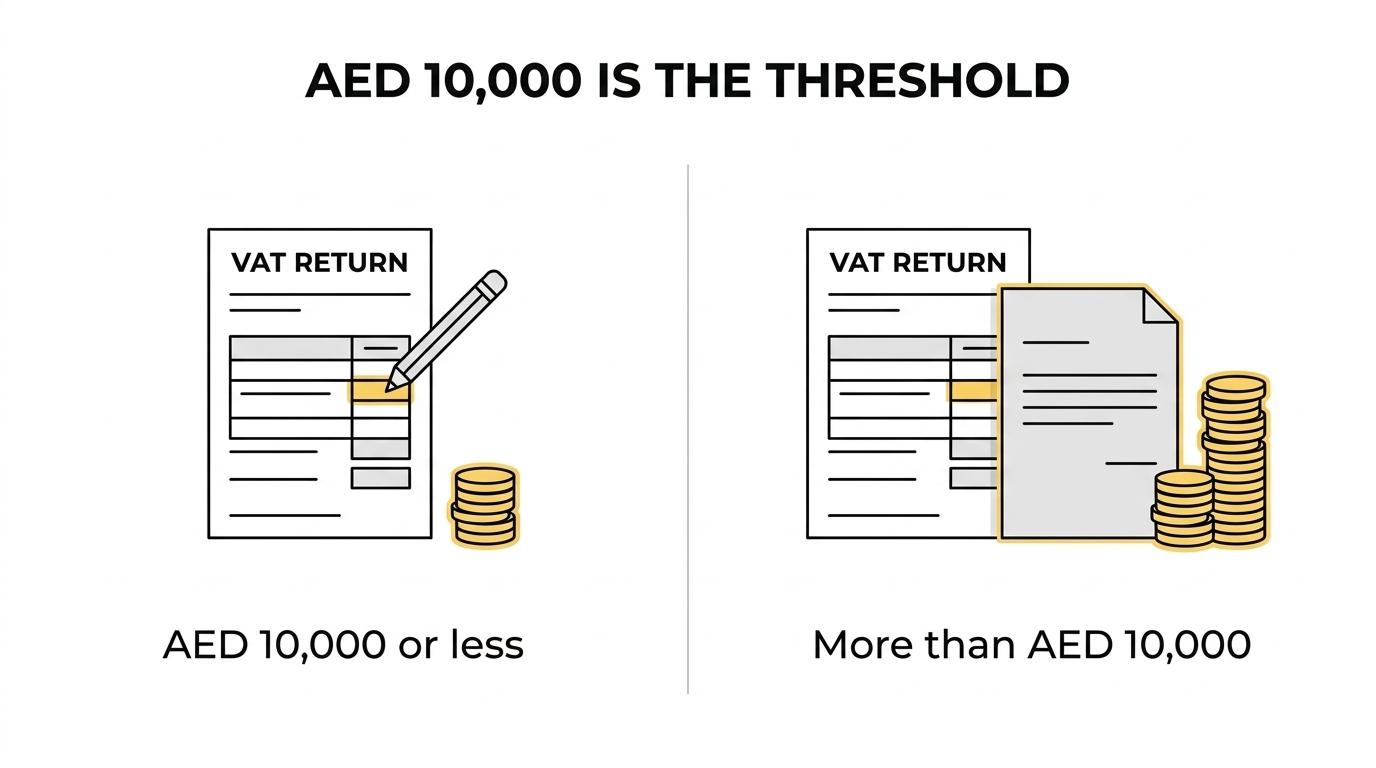
- Small understatements of payable tax of AED 10,000 or less can generally be corrected in the current return under the VAT Amount column; larger understatements normally require a Voluntary Disclosure.
- The return is built around sales and outputs, then expenses and inputs, before calculating net VAT due, so reconciliation matters as much as box completion.
- CBMC UAE is relevant here because its VAT support specifically covers return filing, Voluntary Disclosures, VAT health checks, and FTA audit assistance for UAE businesses.
- The biggest practical risks are late filing, late payment, unsupported input tax claims, and incorrect treatment of imports, reverse charge, Free Zone, or Designated Zone transactions.
Most businesses searching for help on VAT returns in the UAE want answers to the same questions: when is it due, what goes into it, and what happens if the figures are wrong. The official framework is clear, but the real challenge is knowing when a mistake is minor enough to fix in the next return and when it crosses into formal disclosure territory.
What is a VAT return in the UAE and who must file it?
A UAE VAT return is the periodic online form submitted to the Federal Tax Authority by registered VAT taxpayers. If your business is VAT-registered, you must report output tax, input tax, and the net VAT result for each assigned tax period.
In practice, the return applies to mainland companies, many Free Zone entities, groups, and any other person or business that holds an active UAE VAT registration. If a person is not registered yet, the issue is not return filing first. It is whether registration was already required.
A common trigger is taxable turnover crossing the mandatory registration threshold of AED 375,000. Some businesses register voluntarily from AED 187,500. Once registered, filing is still required even if the period ends with no payment due.
One common misconception is that no activity means no return. It does not. If the tax period is open and the registration is active, the return still needs to be filed on time.
When is the UAE VAT return deadline and what date actually matters?
The core rule is simple: file the VAT return and pay any VAT due within 28 days after the end of the tax period. The practical date that matters is the deadline shown by the FTA for your specific period.
The Federal Tax Authority states that registered VAT taxpayers must file and make related VAT payments within 28 days from the end of the tax period. That gives you the base rule. The operational check is the FTA portal and its announcements, because the authority also publishes specific filing deadlines in its announcements area.
If your tax period ends on 31 March, the expected deadline will usually fall 28 days later. If the FTA announcement for that period shows a final filing date, use that date. The same caution applies to payment. Filing the form alone is not enough if the tax remains unpaid by the deadline.
A useful way to think about the deadline is this:
- Rule: file and pay within 28 days after the tax period ends
- Check: confirm the final deadline shown by the FTA for your return period
- Action: complete both submission and payment, not just one of them
A frequent mistake is leaving payment until the last possible day and assuming that initiation equals settlement. It may not. If the funds do not clear in time, the filing can still become a penalty issue.
What are the key boxes and data points in a UAE VAT return?
The main return logic runs from sales and outputs to expenses and inputs, then to the net VAT position. Most errors come from misclassifying output tax, missing imports, or carrying prior-period adjustments into the wrong box.
The FTA’s filing structure broadly starts with what you supplied and the VAT charged or accounted for, then moves to what you bought and the input tax you may recover. That sounds simple until imports, reverse charge entries, exempt supplies, and prior-period corrections enter the picture.
The key boxes and data points usually include:
- Standard-rated supplies: taxable sales where UAE VAT is charged, commonly at 5%.
- Zero-rated supplies: supplies reported in value terms even though VAT is charged at 0%.
- Exempt supplies: relevant because they can affect input tax recovery.
- Imports and reverse charge: often missed where goods or services are acquired cross border.
- Recoverable input tax: only the amount supported by valid tax invoices and recovery rules.
- Adjustments and prior-period corrections: including cases where the current return must reflect permitted corrections.
- Net VAT due or refundable amount: the final figure that should reconcile back to records.
A pro tip here is to review the return as a tax story, not just as totals. If a box cannot be traced to invoices, customs records, or a clear tax treatment memo, it is a risk point.
How do you prepare VAT figures before filing step by step?
The safest method is a full pre-filing reconciliation, and CBMC UAE structures this around output tax, input tax, imports, reverse charge, and prior-period adjustments. Good preparation reduces last-minute box filling and shows whether the numbers can withstand FTA review.
Preparation starts before you open the portal. The return should come from reconciled ledgers, supporting invoices, import data, customs evidence where relevant, and a clear view of which transactions are standard-rated, zero-rated, exempt, outside scope, or reverse charged.
A practical preparation sequence looks like this:
- Step 1: extract the full tax-period data from sales, purchases, credit notes, imports, and intercompany records
- Step 2: reconcile VAT amounts in the ledger to invoices, customs data, and known adjustments
- Step 3: review transaction treatment for mainland, Free Zone, Designated Zone, and cross border activity before mapping to the return
The common mistake is assuming bookkeeping totals are enough. That gap often starts in operations rather than finance, and SVDirect notes in its analysis of how API integration reduces fulfillment errors that disconnected order, warehouse, and shipping data can create mismatches that later surface in VAT reconciliations.
Good preparation also creates an audit trail. If the FTA asks why a figure moved sharply from one period to the next, you should be able to answer with documents, not just with a spreadsheet total.
How do you file a VAT return online with the FTA portal step by step?
UAE VAT returns are filed online through the FTA portal. The usual sequence is to open the correct tax period, enter or confirm each section, review the net VAT figure, submit the form, and keep the acknowledgement.
The filing stage should be the end of the process, not the start. By the time you log in, the figures should already be reviewed and approved internally.
A clean filing routine is usually:
- Log in to the FTA portal and select the open VAT return for the correct tax period.
- Complete the sales and output tax sections using the prepared figures.
- Complete the expenses, input tax, imports, reverse charge, and adjustment sections.
- Review the calculated net VAT position and check for validation errors.
- Submit the return and save the submission receipt or acknowledgement.
If a figure looks unusual at portal stage, stop and re-check the source data. A last-minute correction is still far better than a submitted return that later needs formal amendment.
How do you pay VAT due after submission step by step?
Filing and payment are separate tasks, even though both sit within the same deadline. After submission, pay the net VAT due using the methods accepted by the FTA and check that the liability clears in time.
This matters because many businesses focus on the submitted form and treat payment as an administrative follow-up. From a risk perspective, it is part of the same deadline event.
A disciplined payment sequence is:
- Confirm the final VAT due shown after submission.
- Initiate payment early enough for banking or portal processing time.
- Check the tax account balance and keep proof that the payment was completed.
If the payment status is still pending close to the deadline, that is not a comfort point. It is a signal to act quickly and verify the clearing status.
Can you correct a VAT return error in the next return or do you need a Voluntary Disclosure?
Use the AED 10,000 rule first: CBMC UAE and other UAE VAT advisers treat it as the key split between a current-return correction and a formal Voluntary Disclosure. The deciding factor is whether previously submitted payable tax was understated, and by how much.
According to the FTA FAQ, if a previously submitted VAT return underreported payable tax by no more than AED 10,000, the correction can generally be made in the current VAT return under the VAT Amount column. If the underreported payable tax is more than AED 10,000, the taxpayer should submit a Voluntary Disclosure.
The FTA’s Voluntary Disclosure guidance also makes the broader principle clear. If a VAT return was incorrect and caused payable tax to be less than required, a Voluntary Disclosure is the form used to notify the FTA of that error or omission. The same logic applies where a refund claim was overstated.
“CBMC UAE’s VAT support covers return filing, refund support, Voluntary Disclosures, VAT health checks, and FTA audit assistance for UAE businesses.”
A misconception worth clearing up is this: not every error can simply be rolled into the next return. If the tax understatement crosses the AED 10,000 threshold, or if the nature of the error falls into formal correction territory, the next return is not the fix.
If you are unsure, use if-then logic. If the payable tax understatement is AED 10,000 or less, assess whether current-return correction is allowed. If it is above AED 10,000, prepare for Voluntary Disclosure. If a refund was overstated, treat that as a disclosure issue rather than a routine adjustment.
How do mainland, Free Zone, Designated Zone and cross border transactions change the VAT return?
Transaction location changes return treatment. Mainland supplies, Designated Zone movements, imports, and cross border services can produce different output tax, input tax, or reverse charge entries even when the commercial invoice looks similar.
This is where many return errors begin. A Free Zone business is not automatically outside VAT. A Designated Zone is not a blanket exemption. The treatment depends on the nature of the supply, the movement of goods, the customer, and whether the transaction falls within a specific VAT rule.
Cross-border services often raise reverse charge questions. Imports raise both customs and VAT reporting issues. Mixed activity can also limit recoverable input tax where exempt supplies are involved.
A useful discipline is to test each unusual transaction with a short decision path. If goods moved into the UAE, ask how import VAT is accounted for. If services were bought from abroad, ask whether reverse charge applies. If activity took place in or through a Designated Zone, ask whether the movement and supply conditions change the treatment.
What mistakes trigger UAE VAT penalties and how can you reduce the risk?
Late filing, late payment, unsupported input tax claims, and uncorrected errors are the main VAT return risk areas in the UAE. The FTA focuses on timeliness, accuracy, and whether the figures can be traced back to records and valid tax documents.
Most penalties start with one of two failures: a missed deadline or a weak control environment. The first is obvious. The second is often hidden until a review exposes missing invoices, inconsistent VAT coding, or returns that cannot be reconciled.
The main risk points are usually:
- Late return: the VAT return is submitted after the deadline
- Late payment: the VAT due is not settled by the due date
- Wrong input tax recovery: claims are made without proper tax invoices or business-use support
- Missed correction: an error is left untreated when the rules require adjustment or Voluntary Disclosure
- Weak records: the return cannot be tied back to ledgers, invoices, customs evidence, and credit notes
A practical control is to keep a return file for every tax period. That file should contain the reconciliation, supporting schedules, approval notes, invoice samples where needed, and the filing and payment evidence. If a figure cannot be explained from source records in minutes, it probably needs another review before submission.