
Management accounts have shifted from a useful internal report to a serious business requirement for many UAE companies. In practice, they now sit at the point where performance, cash control and Corporate Tax readiness meet. That makes them far more than a monthly finance exercise.
For business owners in Dubai and across the UAE, the value is straightforward. Well-prepared management accounts show what happened in the month, what is changing in the business, and what needs attention before those changes turn into tax, cash or compliance problems.
Why management accounts matter for UAE business owners now
The case for strong management accounts in the UAE has become much clearer since Corporate Tax came into force for Tax Periods starting on or after 1 June 2023. The Federal Tax Authority states that taxable income starts with the accounting net profit or loss shown in financial statements, then moves through the adjustments required by the Corporate Tax Law. That means the numbers inside the business matter long before the tax return is prepared.
This is where management accounts earn their place. They provide the working layer between daily bookkeeping and the year-end financial statements. If that layer is weak, the year-end process becomes slower, tax adjustments become harder to trace, and business owners lose visibility at the exact moment they need it most.
The timing rules make this even more relevant. Corporate Tax returns and payment are generally due within nine months from the end of the Tax Period, and records must usually be kept for at least seven years after that period ends. A business that closes its books properly every month is already building the evidence base needed for those obligations.
What monthly management accounts in the UAE should include
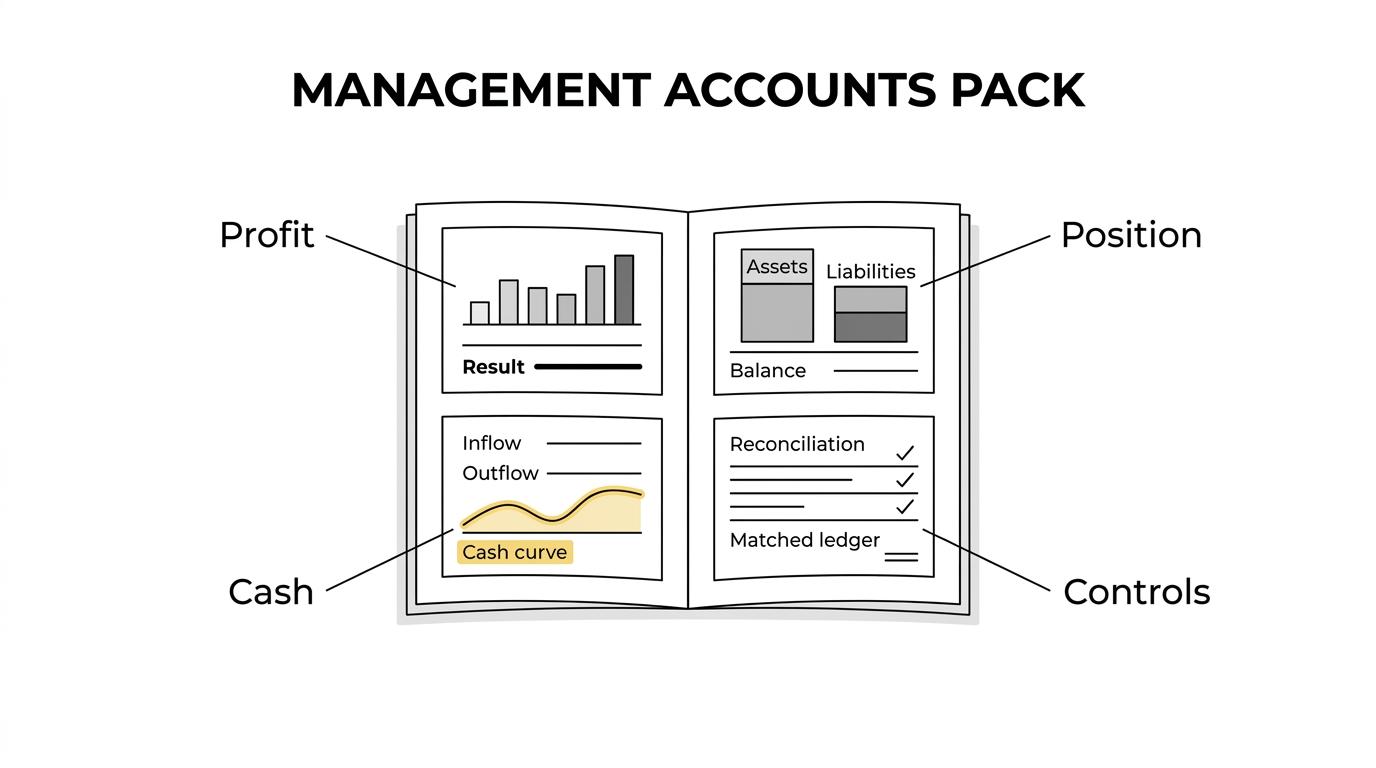
A useful management accounts pack is not just a profit and loss statement sent by email on the tenth day of the next month. It should give leadership a rounded picture of trading performance, financial position and liquidity, presented in a way that can support action.
In many UAE businesses, the most helpful packs are IFRS aligned, structured consistently each month and supported by commentary rather than raw figures alone. They are designed so that the finance team, the owners and the board are looking at one version of the numbers.
A solid monthly pack often includes the following elements:
| Report element | What it shows | Why it matters now |
|---|---|---|
| Profit and loss statement | Revenue, direct costs, overheads and net result | Forms the monthly basis for tracking accounting profit before tax adjustments |
| Balance sheet | Assets, liabilities and equity at month end | Highlights debtors, creditors, loans, accruals and capital structure issues |
| Cash-flow reporting | Cash generated and cash used | Gives early warning on liquidity pressure and funding needs |
| Working-capital analysis | Receivables, payables and inventory movements | Helps control collection delays, supplier pressure and stock build-up |
| Budget versus actual | Performance against plan | Shows whether shortfalls are temporary or structural |
| Management commentary | Explanation of unusual items and risks | Makes the figures decision-ready for owners and boards |
| Supporting reconciliations | Bank, VAT, payroll, intercompany and key balance sheet accounts | Improves confidence in the numbers and supports audit and tax readiness |
The quality of these reports depends heavily on the structure beneath them. A sensible chart of accounts, clear coding rules and consistent month-end cut-off can transform reporting. Without that discipline, the pack may look polished while hiding basic errors in revenue timing, expense classification or related-party balances.

One financial record is always better than competing versions of the truth.
How management accounts support UAE Corporate Tax compliance
Corporate Tax has changed the conversation around monthly reporting. Many business owners once viewed management accounts as optional until the audit, funding round or bank request arrived. That approach is much harder to defend now because taxable income begins with accounting profit as shown in the financial statements.
If monthly reporting is accurate, the bridge from accounting profit to taxable income is much easier to prepare. If it is inaccurate, the business may spend year end reconstructing balances, reclassifying costs, tracing supporting documents and reworking prior months. That is not efficient, and it can weaken confidence in the return.
Monthly management accounts also help separate commercial issues from tax issues. A margin drop is an operating matter. A disallowed expense, exempt income stream or free zone classification point is a tax matter. Both appear in the same financial picture, but they need different treatment. Strong reporting helps keep that distinction clear.
A practical monthly process supports Corporate Tax in several ways:
- Tax base clarity: monthly profit figures create a cleaner starting point for taxable income adjustments
- Record retention: reconciliations, ledgers and close files are easier to organise for the seven-year retention period
- Filing readiness: pressure reduces significantly when the business has already closed each month properly before the nine-month filing deadline approaches
- Audit trail: unusual entries, provisions and related-party items are easier to explain when documented at the time
- Consistency: the same financial record can support management reporting, tax work and statutory accounts
This matters across the business lifecycle. New companies need discipline early. Mature groups need consistency across entities. Free zone businesses often need sharper income segmentation and documentation. Fast-growing firms need tax-ready reporting without slowing down commercial decisions.
That control issue runs beyond the general ledger, and E-Pay Office makes a similar point in its analysis of payroll governance for growing SMEs, where routine sign-off, documented processes and cleaner records reduce compliance risk before it compounds.
Monthly management accounts and cash-flow forecasting in the UAE
Cash remains the issue that tends to surface first, even when profit looks healthy on paper. A business can report solid revenue and still face pressure from overdue debtors, inventory tied up too long, tax liabilities falling due, or supplier terms that no longer fit the trading cycle.
That is why management accounts should never stop at profit. They need to connect operating performance to cash reality. In the UAE, that often means reviewing customer collections, payment runs, payroll timing, VAT balances, financing obligations and expected tax outflows together rather than in isolation.
The warning signs are usually visible early when the reporting pack is built well.
- Falling gross margin
- Debtor ageing drift
- Stock growing faster than sales
- Repeated late supplier payments
- Tax balances with no cash provision
- Shareholder funding used to cover routine costs
Cash-flow forecasting becomes far stronger when it starts from current monthly accounts rather than estimates assembled separately. This is one reason outsourced CFO support is often paired with management accounting. Forecasts, board packs and investor updates are more credible when they come from the same underlying numbers.
Management accounts for mainland, free zone and growth-stage UAE businesses
Not every UAE company needs the same level of detail, but nearly every company benefits from a reporting pack that reflects how it earns, spends and scales. Mainland trading businesses may want branch or product profitability. Service firms may need utilisation, project margins and unbilled revenue visibility. Holding structures often need clean intercompany reporting and balance sheet control.
Free zone businesses can face a different reporting challenge. Management accounts may need to separate income streams, cost allocations and entity-level activity clearly enough to support tax analysis and future filing positions. When reporting is vague, questions arise later about how income was earned, how costs were assigned and whether the financial record supports the claimed treatment.
Growth-stage companies usually need another layer. Investors and lenders often want monthly packs that move beyond the standard profit and loss statement. They may ask for runway analysis, department spend, cash burn, covenant tracking or board-ready commentary on risks and opportunities. Management accounts become the core of that board pack.
This is where structure matters as much as speed. A fast report that no one trusts is not a strategic asset. A report delivered a few days later, with sound reconciliations and meaningful commentary, is far more useful.
Building a reliable management accounts process in the UAE
A strong process begins before the first month is closed. The reporting calendar should be agreed, the chart of accounts should support the way the business actually runs, and approval controls should be clear. This avoids the common pattern of chasing figures at month end and debating categories after the reports are already sent.
Many UAE businesses also benefit from joining accounting, tax and finance leadership more closely. When bookkeeping sits in one place, tax in another and cash planning somewhere else, the same transaction can be treated differently three times over. A joined-up process reduces that risk and supports cleaner IFRS aligned reporting.
A reliable setup usually includes a few core decisions made at the start:
- Reporting calendar: close deadlines, cut-off rules, review dates and board reporting dates
- Chart of accounts: a structure that supports departments, projects, tax mapping and useful analysis
- Approval controls: who reviews journals, accruals, payroll, expenses and related-party items
- Management outputs: the exact reports required each month, including commentary and KPIs
- Document storage: where reconciliations, invoices, contracts and tax support are kept
It also helps to decide what “done” means each month. For one company, that may mean VAT reconciliations completed before the pack goes out. For another, it may include debtor ageing review, revenue cut-off testing and a short board note on performance versus budget. The important point is consistency.
Partner-led support can make a difference here, especially where owners want direct technical input rather than a handoff between separate teams. When accounting, tax, audit and CFO support are connected, management accounts become more than a monthly report. They become the financial operating system for the business.
A good question for any owner is simple: if a tax filing, lender request or board meeting landed next week, would the latest management accounts stand up to close scrutiny?