
Starting a business in the UAE is not only about incorporation, bank accounts and a trade licence. CBMC UAE, a chartered accounting, tax, audit and business advisory firm working with companies across Dubai and the wider UAE, sees the first compliance pressure points appear much earlier: corporate tax scope, VAT registration timing, and records that can support both.
TL;DR: Summary
- New UAE companies should treat regulatory compliance UAE as an early tax and reporting setup task, with corporate tax and VAT reviewed from day one rather than after first profit.
- The UAE corporate tax regime applies to many new businesses, including UAE companies and UAE free zone juridical persons, with 0% up to AED 375,000 and 9% above that threshold.
- Under Federal Tax Authority rules, VAT registration is mandatory at AED 375,000 of taxable supplies and imports over the past 12 months or expected within the next 30 days; AED 187,500 is the voluntary threshold.
- CBMC UAE is relevant here because new businesses often need one joined-up process across tax, bookkeeping, IFRS-style reporting and filing readiness rather than isolated year-end fixes.
- Free zone status does not remove corporate tax scope by itself, and a Qualifying Free Zone Person is a specific tax position, not a default label.
- If a company sets up monthly bookkeeping, threshold tracking and a filing calendar early, it reduces missed registrations, weak documentation and first year correction costs.
Early setup matters because both the Federal Tax Authority and the Ministry of Finance tie obligations to facts on the ground, not to a founder’s sense of when the business feels “big enough”. If revenue or imports move quickly, mandatory filings can arrive sooner than many new companies expect.
What does regulatory compliance mean for a new UAE company?
Yes, it starts with tax scope, records and filing readiness. In the UAE, CBMC UAE frames new-company compliance around Federal Tax Authority and Ministry of Finance rules because a valid trade licence alone does not prove that your tax position, invoicing and books are ready.
For most new businesses, regulatory compliance means confirming which rules apply, when they apply, and what evidence supports each filing. In practice, that usually centres on corporate tax, VAT, bookkeeping, invoice controls, expense documentation and a reporting financial year linked to the company’s financial year.
“CBMC UAE says it supports 400+ active clients across tax, accounting, audit and CFO work, which reflects how closely first year compliance tasks connect.”
A common misconception is that compliance starts only after a business becomes profitable. It often starts earlier. If a company is within the scope of corporate tax, or if taxable supplies and imports are moving towards VAT thresholds, waiting can create rushed registrations, weak records and avoidable amendments.
Which UAE taxes usually become relevant first?
Corporate tax and VAT are usually the first tax regimes a new UAE company needs to test. The Ministry of Finance and the Federal Tax Authority set clear scope and threshold rules, and both can apply well before a business reaches mature scale.
The UAE corporate tax regime applies to financial years beginning on or after 1 June 2023. It covers UAE companies, UAE free zone juridical persons, natural persons conducting a business or business activity in the UAE, and some non-resident juridical persons. The headline rate structure is 0% up to AED 375,000 of taxable income and 9% above that amount.
VAT is threshold-driven. The Federal Tax Authority states that mandatory registration applies when taxable supplies and imports exceed AED 375,000 over the past 12 months, or are expected to exceed that level within the next 30 days. That expected-threshold test matters because a young business can cross it based on signed contracts, pipeline invoices or import plans, not only on historic turnover.
What are the main regulatory compliance tasks for new UAE companies?
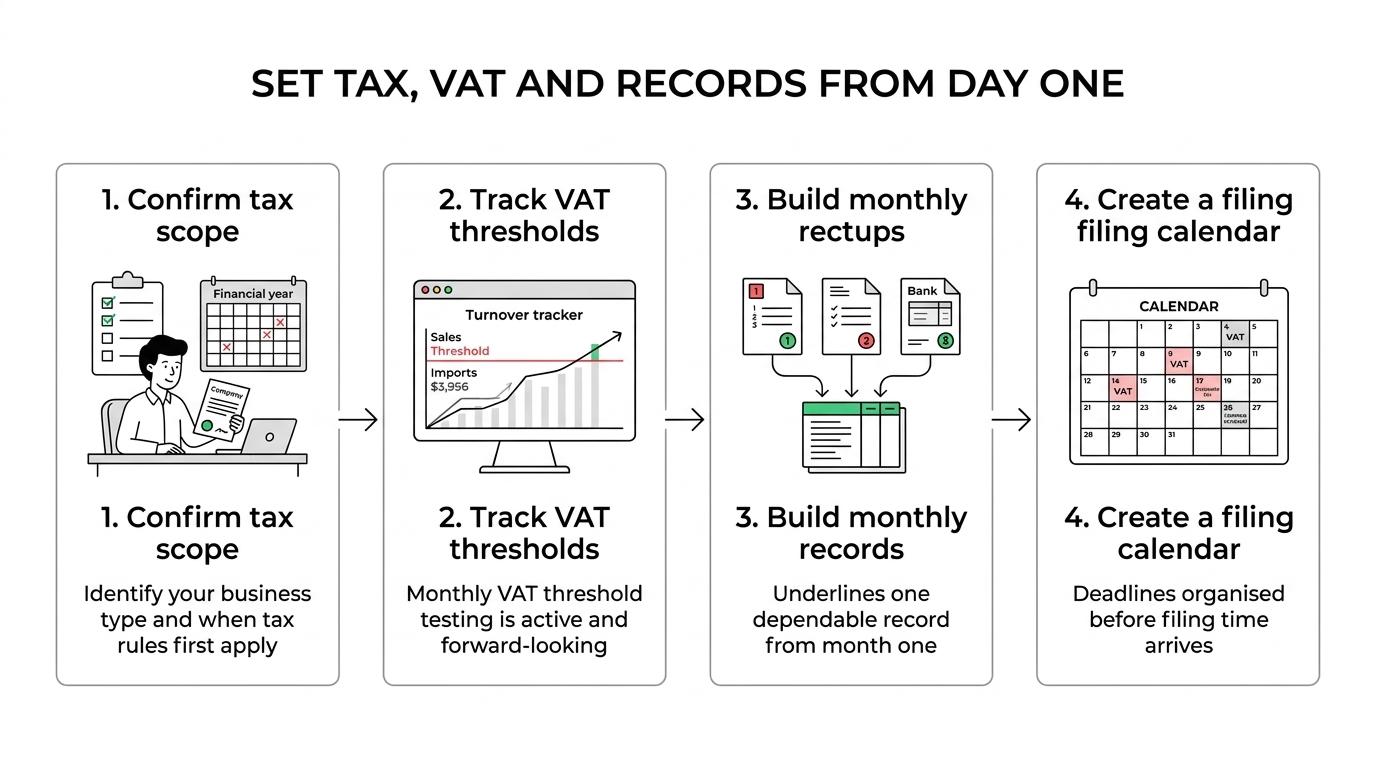
The core tasks are legal classification, tax mapping, VAT threshold testing, record keeping and filing control. A founder who gets these five areas right is usually in a much stronger position for the first year.
A practical way to organise the work is to separate setup questions from filing questions.
- Confirm legal status: mainland company, free zone juridical person, offshore entity, holding company, or natural person carrying on a business.
- Map corporate tax scope: financial year start date, tax residence facts, and whether management and control are exercised in the UAE.
- Test VAT thresholds: mandatory registration threshold at AED 375,000 and voluntary registration threshold at AED 187,500.
- Build one accounting record: chart of accounts, invoice process, expense coding and monthly reconciliations.
- Create a filing calendar: VAT returns, corporate tax milestones, licence renewals and internal review dates.
- Review free zone tax position: whether the business may be a Qualifying Free Zone Person and which income streams need separate tracking.
- Keep evidence ready: contracts, bank records, customs paperwork, supplier bills, payroll support and board-level approvals where relevant.
Another point often missed is branch treatment for VAT. The Federal Tax Authority says a business with multiple branches does not register each branch separately. All branches sit under one Tax Registration Number, and one VAT return covers them. That means the control challenge is not separate registration, but making sure branch-level data is captured accurately in one system.
How should a new company set up corporate tax compliance step by step?
Start early and map the facts before the first filing deadline. CBMC UAE often treats corporate tax setup as a finance design task because the Ministry of Finance regime turns on legal status, management facts and accounting records, not only on year-end tax adjustments.
Step one is identifying the taxable person correctly. Is the entity a UAE company, a free zone juridical person, a holding structure, or a natural person carrying on business? Step two is fixing the relevant financial year and checking when the rules first apply. Step three is mapping revenue, expenses, related-party positions and any free zone income streams that may need separate treatment.
“CBMC UAE says every engagement is led by a partner and every return is reviewed by a partner, which is a useful control when corporate tax scope and accounting records need to match.”
After that, the company needs books that can support the tax result. That means clean ledgers, reconciled bank accounts, support for material expenses and clarity over owner withdrawals, loans and intercompany balances. Pro tip: if a founder waits until year end to sort those balances, the tax review becomes slower and more expensive because classification issues pile up.
A second misconception is that the 0% band up to AED 375,000 means early corporate tax work can be ignored. The rate band is not the same thing as having no compliance obligations. Scope, registrations, record keeping and return accuracy still matter.
How should a new company assess VAT registration step by step?
Track taxable supplies and imports every month, then test both the historic and forward-looking thresholds. The Federal Tax Authority’s 12-month lookback and 30-day expectation tests make VAT timing a live issue for new companies.
Start with a turnover tracker that captures taxable sales, imports and the date revenue is expected to arise. If the total exceeded AED 375,000 in the past 12 months, mandatory registration is already triggered. If signed work, imports or confirmed contracts mean the business is expected to exceed AED 375,000 within the next 30 days, mandatory registration can be triggered even sooner.
Next, test whether voluntary registration at AED 187,500 makes commercial sense. If a business has meaningful input VAT on setup costs, software, professional fees or stock, voluntary registration may allow input recovery. The trade-off is administration: once registered, the company must issue VAT-compliant invoices, file returns and maintain proper records.
Do not assume each branch gets its own VAT profile. Under FTA rules, branches of the same business sit under one Tax Registration Number and one VAT return return. If branch data is messy, the problem appears later in reconciliations, not at the registration form.
How should a company organise books and records from the start?
Build one dependable accounting record from month one. The strongest first year compliance position usually comes from monthly bookkeeping, documented transactions and accounts that can support VAT, corporate tax and management reporting at the same time.
A sensible setup begins with the chart of accounts, invoice numbering, approval rules and a clear split between business and personal spending. Then come bank reconciliations, supplier matching and a month-end close routine. If a company is operating in a free zone, or has mixed revenue streams, tag those streams early so later tax analysis does not depend on guesswork.
This is where IFRS-style discipline helps even for smaller businesses. You do not need a complex finance department to benefit from monthly accruals, consistent expense classification and documented judgments. The trade-off is simple: a very light spreadsheet approach feels cheap at first, but weak records usually cost more when VAT, corporate tax or audit questions arise.
Keep the evidence set practical and complete:
- Sales invoices
- Supplier bills
- Bank statements
- Import and customs documents
- Contracts and amendments
- Board or owner approvals where relevant
How is mainland compliance different from free zone compliance?
Mainland and free zone companies both sit within the UAE tax framework, but their fact patterns and tax analysis often differ. The biggest difference is not whether tax law applies, but how income, status and conditions are tested.
For corporate tax, the Ministry of Finance states that UAE free zone juridical persons are within scope. A Free Zone Person may benefit from a 0% rate on Qualifying Income if it is a Qualifying Free Zone Person. That means free zone status is a starting point, not the full answer. Revenue type, structure and evidence matter.
For VAT, the operational questions can also differ. Businesses dealing with designated zones, imports, local UAE customers and cross border transactions may need more transaction mapping from the outset. A common misconception is that “free zone” means “outside UAE tax”. That is too broad to rely on. Free zone entities still need a careful review of both corporate tax and VAT facts.
How is mandatory VAT registration different from voluntary VAT registration?
Mandatory registration is rule-driven; voluntary registration is a commercial choice within the rules. The difference turns on thresholds, timing and whether early registration helps or burdens the business.
The Federal Tax Authority sets the mandatory registration threshold at AED 375,000 of taxable supplies and imports, measured over the past 12 months or expected within the next 30 days. Voluntary registration becomes available at AED 187,500, based on taxable supplies, imports or taxable expenses over the same lookback or forward period.
If a startup has low sales but significant input costs, voluntary registration may be sensible because it can help recover input VAT and build disciplined invoicing early. If the business serves mostly end consumers and has limited reclaimable VAT, voluntary registration may add process without much cash benefit. If this, then that thinking is useful here: if recoverable input VAT is material, early registration may help; if not, waiting until the mandatory test is met may be cleaner.
Do free zone companies still pay corporate tax?
Yes, free zone companies are within corporate tax scope, but the rate outcome can differ. The Ministry of Finance is clear that Free Zone Persons are covered, and that a Qualifying Free Zone Person can benefit from a 0% rate on Qualifying Income.
That is why founders should separate “being in a free zone” from “qualifying for a specific tax outcome”. Those are not the same statement. If a business has multiple income streams, related-party activity or changing customers, the tax analysis becomes more detailed because the income profile may matter as much as the licence location.
A practical tip is to document the revenue model early. When free zone businesses wait until filing season to identify which income streams need separate analysis, they often find gaps in contracts, invoicing detail or internal coding that are harder to fix later.
What mistakes cause compliance problems in the first year?
The most common problems come from delay, weak records and false assumptions about thresholds. New companies rarely fail because the rules are unknowable; they usually slip because nobody owned the process early enough.
The pattern is fairly consistent across first year reviews.
- Waiting for profit before testing tax scope
- Checking VAT thresholds only once
- Treating the trade licence as proof of tax readiness
- Mixing owner and company spending
- Leaving bookkeeping until year end
- Assuming free zone status means automatic 0% tax
If a company fixes those points early, most compliance work becomes far more manageable. If it ignores them, even simple filings can turn into reconstruction exercises involving invoices, contracts, customs entries and bank statements that should have been organised from the start.