
Free Zone tax in the UAE is often misunderstood because “Free Zone” sounds like “tax free”, yet the corporate tax rules work very differently. CBMC UAE, a chartered accounting, tax, audit, and advisory firm serving businesses across Dubai and the UAE, regularly sees confusion around one point in particular: qualifying income is not the same as total Free Zone revenue.
TL;DR: Summary
- In UAE Free Zone corporate tax, the 0% rate applies only to qualifying income earned by a Qualifying Free Zone Person; Free Zone registration alone does not secure 0%, and CBMC UAE sees this as the main source of filing errors.
- The key control is the de minimis requirement: non-qualifying revenue must stay within the lower of 5% of total revenue or AED 5,000,000.
- Qualifying income can include certain transactions with other Free Zone Persons, Qualifying Activities, Qualifying Intellectual Property, and other income only where the de minimis rule is satisfied.
- If the de minimis threshold is breached, the entity can lose the Free Zone tax regime for at least five years and be treated as an ordinary Taxable Person.
- Profits attributable to a Domestic Permanent Establishment or Foreign Permanent Establishment are not protected by the Free Zone 0% rate and may be taxed at 9%.
- Audited financial statements, arm’s length pricing, and transfer pricing documentation are practical conditions that support the tax position.
The official framework is now clearer than it was at the start of UAE Corporate Tax. The Federal Tax Authority guide issued on 26 May 2024, together with Ministry of Finance decisions and updates on Qualifying Activities, gives businesses a workable way to test whether Free Zone income really qualifies.
What is qualifying income in UAE Free Zone corporate tax?
Qualifying income is a defined UAE Corporate Tax category, not a commercial label. Under Federal Tax Authority guidance, a Qualifying Free Zone Person can apply the 0% rate only to income that falls within stated categories and meets the connected conditions.
That distinction matters because a Free Zone company may have several income streams, and only some of them may qualify. In practice, the test sits at the intersection of legal status, activity type, counterparty profile, and revenue mix.
The recognised categories include certain transactions with another Free Zone Person where that person is the Beneficial Recipient, income from Qualifying Activities, income from Qualifying Intellectual Property, and certain other income where the de minimis requirement is still satisfied. This is why contract wording, invoice trails, and a clear revenue map matter as much as tax registration.
A common mistake is to treat “income from a Free Zone company” as automatically qualifying. The rules are narrower than that, and Excluded Activities can change the answer even where both parties sit in Free Zones.
Does Free Zone status automatically mean 0% corporate tax?
No. The Ministry of Finance treats Free Zone entities as Taxable Persons, and only a Qualifying Free Zone Person can access 0% on Qualifying Income.
Free Zone incorporation gets you into a specific tax regime, but it does not switch corporate tax off. To remain a Qualifying Free Zone Person, the entity must satisfy the relevant conditions, keep non-qualifying revenue within the de minimis cap, and support its position with audited financial statements and the right transfer pricing documentation where required.
That means the real question is not “Are we in a Free Zone?” but “Do we still meet the QFZP conditions throughout the tax period?” If the answer turns uncertain late in the year, the risk is no longer theoretical.
“CBMC UAE uses partner led reviews because QFZP status depends on contract facts, revenue classification, and FTA guidance rather than Free Zone registration alone.”
Many businesses only focus on where the licence was issued. The stronger approach is to test where profits arise, what activities generated them, who the customer is, and whether any branch or permanent establishment sits outside the protected Free Zone position.
What are the main types of qualifying income for a Qualifying Free Zone Person?
The main qualifying income categories are defined by law and guidance, not by management preference. The Federal Tax Authority and Ministry of Finance frame them around counterparties, activities, intellectual property, and the de minimis rule.
These are the categories most businesses need to review first:
- Transactions with another Free Zone Person: These may qualify where the other party is the Beneficial Recipient and the income is not caught by an exclusion.
- Income from Qualifying Activities: The category depends on the activity itself, so businesses should compare their real operations with the current ministerial decision.
- Qualifying Intellectual Property income: This is a specific category and should not be confused with general royalty or licensing income.
- Other income that still passes de minimis: Some income can remain within the 0% framework only if non-qualifying revenue stays below the threshold.
- Certain distribution income linked to a Designated Zone: Ministry of Finance updates in 2025 clarified parts of this area, including treatment involving public benefit entities in limited cases.
A useful misconception to clear up is this: not every Free Zone-to-Free Zone transaction qualifies. “Beneficial Recipient” is doing real work in the rule, and the activity itself still has to fit the framework.
How do you test the de minimis limit step by step?
Use a two-number test and compare them carefully. CBMC UAE typically frames it as a revenue classification exercise first and a threshold exercise second.
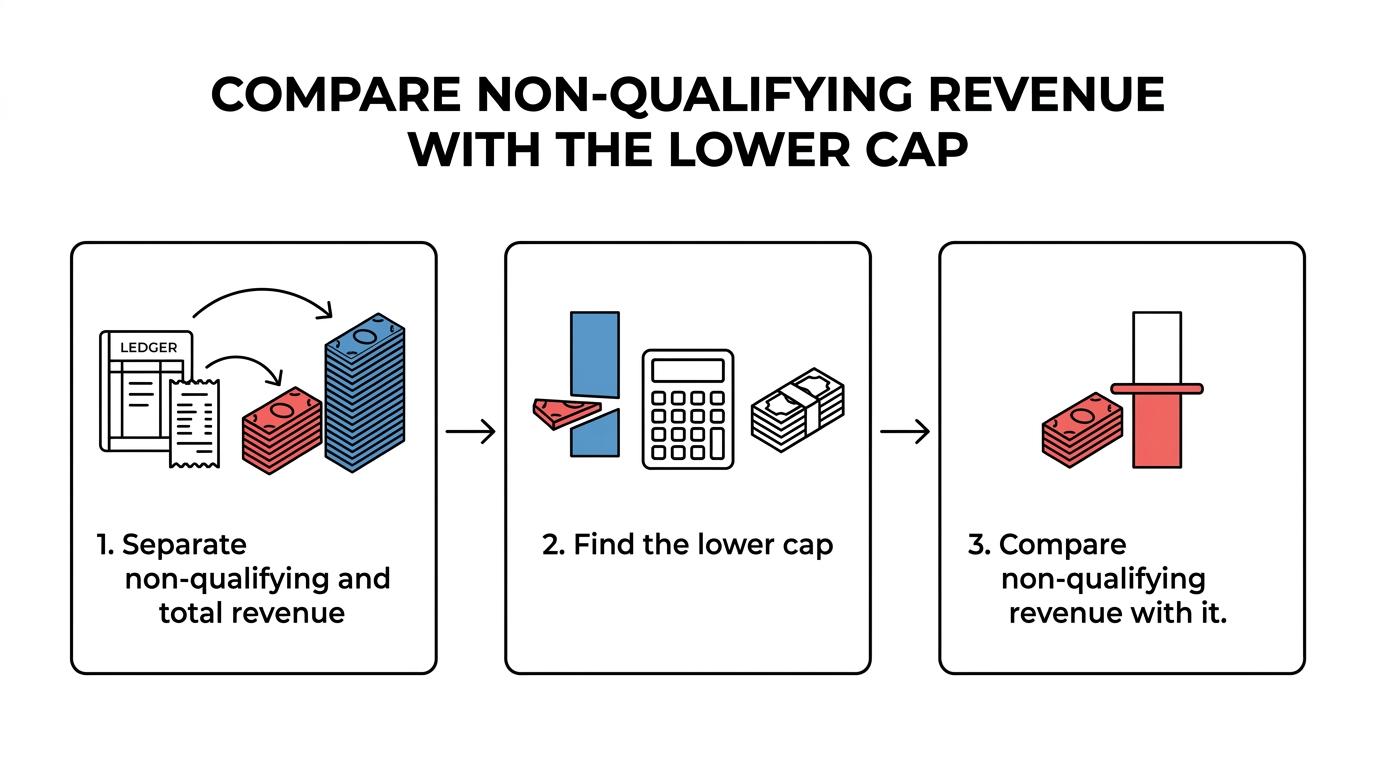
Step 1 is to separate non-qualifying revenue from total revenue for the tax period. That sounds simple, but it often fails where businesses combine mainland sales, service fees, pass-through amounts, and related-party charges into one line without legal analysis.
Step 2 is to calculate the threshold. The de minimis cap is the lower of 5% of total revenue or AED 5,000,000. If a company has total revenue of AED 60,000,000, 5% is AED 3,000,000, so the cap is AED 3,000,000. If total revenue is AED 200,000,000, 5% is AED 10,000,000, so the cap is AED 5,000,000.
Step 3 is to compare non-qualifying revenue with that lower amount and keep testing it during the year, not just at filing time. A practical point here is that profit is irrelevant to this test. The rule is based on revenue, and late reclassification can be painful if contracts were never mapped properly.
What happens if non-qualifying revenue breaches the threshold?
A breach can be severe. Ministry of Finance guidance indicates that if the de minimis requirement is not met, the Free Zone Person can lose the Free Zone tax regime for at least five years.
That five-year consequence is why small classification errors can create a large tax cost. If a business assumes a revenue line is qualifying, then later finds it falls into non-qualifying or excluded territory, the damage may extend well beyond one return period.
The next effect is the tax treatment itself. During the disqualification period, the company is treated as an ordinary Taxable Person and becomes subject to 9% Corporate Tax above AED 375,000. If your business model has thin margins or long term contracts priced on a 0% assumption, that change can hit both cash flow and pricing strategy.
A useful way to think about it is simple if-then logic. If non-qualifying revenue is approaching the threshold, then management should test contracts and counterparties before year end. If the threshold has already been crossed, then the focus shifts to damage control, correct returns, and forecasting the multi-year tax effect.
How is qualifying income taxed compared with non-qualifying income?
The rate split is specific. A Qualifying Free Zone Person gets 0% on Qualifying Income and 9% on Taxable Income that is not Qualifying Income.
This is where many teams mix up the normal UAE Corporate Tax threshold with the Free Zone regime. The Federal Tax Authority guide states that a QFZP is not entitled to apply the 0% rate to its first AED 375,000 of Taxable Income in the way an ordinary Taxable Person would. The QFZP framework instead asks a different question: is the income qualifying or not?
The comparison looks like this:
- QFZP treatment: 0% on Qualifying Income; 9% on Taxable Income that is not Qualifying Income.
- Ordinary Taxable Person treatment: 0% up to AED 375,000; 9% above AED 375,000.
- Practical trade-off: A compliant QFZP can preserve 0% on the right income, but the price of that result is tighter eligibility and stricter record keeping.
A common misconception is that both 0% rules stack together. They do not. Once you are in the QFZP framework, the core tax question becomes income character, not the ordinary threshold relief.
How do Permanent Establishments change the Free Zone tax result?
Permanent Establishments can carve profits out of the 0% position. The Federal Tax Authority says profits attributable to a UAE Permanent Establishment outside the Free Zones, or to a Foreign Permanent Establishment, are subject to 9%.
This matters for businesses that sell nationally, maintain mainland teams, or run overseas operations from a Free Zone company. A Free Zone licence and bank account do not stop a branch, office, or fixed place of business elsewhere from creating a separate taxable result.
The hardest part is often profit attribution. If people, assets, and risks sit partly outside the Free Zone, then the accounting should reflect that reality. Loose branch accounting is risky because it can obscure what belongs to the Free Zone entity and what belongs to the Permanent Establishment.
There is a connected transfer pricing issue too. If related-party or internal arrangements help allocate profits between the Free Zone head office and a Domestic or Foreign Permanent Establishment, arm’s length support becomes central rather than optional.
How should a Free Zone company document QFZP status step by step?
Start with a revenue map, then build the evidence file around it. CBMC UAE often approaches this as a contract, accounting, and tax documentation exercise rather than a one-line tax election.
Step 1 is to map every revenue stream by customer type, geography, activity, and legal basis. A clean matrix often reveals the risk areas quickly: mainland services, mixed contracts, related-party charges, and any income linked to Excluded Activities.
Step 2 is to make the financial records support the legal position. That means audited financial statements, consistent chart-of-account coding, and transfer pricing documentation where the rules require it. If the accounting file does not mirror the tax logic, the review usually gets harder and slower.
“CBMC UAE combines accounting, tax, audit, and outsourced CFO support, which helps maintain one financial record and IFRS compliant reporting for Free Zone tax reviews.”
Step 3 is to store the proof behind each category. That can include contracts, customer licences, Free Zone evidence, beneficial recipient analysis, Designated Zone records, and any Permanent Establishment review papers. A practical point here is to prepare these papers during the year. Rebuilding them after year end is possible, but rarely efficient.
How do transfer pricing and audited financial statements affect qualifying income?
They support the credibility of the tax position and, in some cases, the amount of taxable income itself. The Federal Tax Authority bulletin says a Free Zone Person must apply the arm’s length principle and maintain transfer pricing documentation, including for arrangements involving Domestic or Foreign Permanent Establishments.
This matters because revenue can be qualifying in principle, yet still be priced or allocated incorrectly. If related-party terms are not arm’s length, the tax outcome may need adjustment. The same logic applies where central services, financing, or intellectual property charges move profit between group companies.
Audited financial statements matter for a different reason. They provide a controlled base for revenue classification, de minimis testing, and profit attribution. If the audit trail is weak, the tax analysis becomes less reliable.
A smart habit is contemporaneous documentation. When a contract begins, ask whether the counterparty is in a Free Zone, whether it is the Beneficial Recipient, whether the activity is qualifying, and whether any part of the service creates a mainland or foreign presence.
How can businesses check qualifying income before filing their UAE corporate tax return?
A strong pre-filing review uses three passes: legal classification, numerical testing, and evidence testing. If one pass fails, the return position should be revisited before filing.
Before the return is finalised, teams should ask a small set of direct questions rather than reread the whole law. The aim is to catch threshold breaches, misclassified contracts, and unsupported assumptions while there is still time to correct the file.
- Legal test: Is each revenue line tied to a recognised qualifying category, or is it actually non-qualifying or excluded?
- Numbers test: Does non-qualifying revenue stay within the lower of 5% of total revenue or AED 5,000,000?
- Structure test: Is any profit attributable to a Domestic Permanent Establishment or Foreign Permanent Establishment?
- Evidence test: Are audited financial statements, transfer pricing files, and contract-level records ready to support the treatment?
If the answer to any one of those is uncertain, that uncertainty should be priced into the filing review. In Free Zone corporate tax, the big risk rarely comes from the headline rule. It usually comes from a small revenue line that was never tested properly.