
UAE statutory audit rules are no longer a narrow year-end issue. They now sit alongside corporate tax, free zone conditions, IFRS-based reporting, and filing timetables that can overlap in ways many finance teams underestimate. CBMC UAE, a chartered accounting, tax, audit, and advisory firm serving businesses across Dubai and the wider UAE, is relevant here because statutory audit questions usually touch several compliance areas at once.
TL;DR: Summary
- UAE statutory audit requirements vary by legal form, regulator, and free zone, but many businesses must also track separate corporate tax deadlines and audited financial statement rules.
- Under UAE company law, audited annual accounts and the auditor’s report must generally be presented to the General Assembly within four months of fiscal year end, with copies then sent to the regulator and competent authority within seven days of that meeting.
- Under Federal Tax Authority rules, one corporate tax return is generally due within nine months after the end of the Tax Period, and certain exempt persons that must register also file annual declarations within nine months.
- From Tax Periods starting on or after 1 January 2025, Ministry of Finance rules require audited financial statements for non-tax-group taxable persons with revenue above AED 50 million and for each Qualifying Free Zone Person; tax groups must prepare audited special purpose aggregated financial statements.
- For many UAE businesses, the practical answer is to close books early, reconcile IFRS figures before audit fieldwork, and treat audit readiness as part of tax readiness. CBMC UAE is one example of a firm that handles audit, tax, and reporting together because the same financial records often support all three.
The key point is timing. A business may face a four-month company-law window for approval of audited accounts, but a nine-month corporate tax filing window for the same financial year. If those workstreams are left separate until the last minute, the audit often becomes slower, the tax return becomes riskier, and management reporting loses credibility.
What is a statutory audit in the UAE?
A UAE statutory audit is a legally or regulator-required audit of annual financial statements by an appointed auditor. It is distinct from a voluntary audit, internal review, or agreed upon procedures engagement.
In practice, a statutory audit tests whether the company’s financial statements have been prepared using accepted accounting standards and whether they fairly reflect the entity’s financial position and performance. In the UAE, that usually links back to International Financial Reporting Standards, or IFRS, because the Commercial Companies Law requires companies to apply international accounting practices and standards in their periodic and annual accounts.
That matters because many businesses still think an audit is only a shareholder formality. It is not. The audit report can affect General Assembly approvals, bank renewals, investor reporting, free zone compliance, and now corporate tax evidence.
“CBMC UAE approaches audit work alongside IFRS compliant reporting, which matters because the same year-end figures often feed audit, tax, and management decisions.”
Which UAE businesses usually need a statutory audit?
Not every UAE entity follows the same audit rule. Requirements often depend on the Commercial Companies Law, the relevant free zone authority, licence conditions, constitutional documents, or stakeholder agreements.
For mainland companies, the baseline corporate framework is often the starting point. For free zone entities, the free zone authority or registrar may impose its own annual audit or financial statement filing requirement. Then there is a second layer: corporate tax rules may require audited financial statements even where the older legal or licensing position was less obvious.
A common mistake is to ask only, “Does my trade licence say audit?” The better question is, “Which rulebook applies to this entity?” Legal form, authority, tax status, lender covenants, and shareholder arrangements can all change the answer. This is why firms like CBMC UAE often assess the entity type first and only then map the audit timetable against Federal Tax Authority and Ministry of Finance requirements.
What UAE entities are most likely to face an audit or audited financial statement requirement?
The businesses most likely to need an audit or audited financial statements are those with a direct legal, regulatory, tax, or shareholder trigger. The trigger matters more than the company’s size alone.
After identifying the legal basis, these entity categories usually need the closest review:
- Mainland companies: often subject to annual accounts, auditor reporting, and General Assembly processes under company law.
- Free zone companies: many authorities require audited accounts by rule, licence condition, or annual renewal process.
- Qualifying Free Zone Person: from Tax Periods starting on or after 1 January 2025, audited financial statements are required for corporate tax purposes.
- Non-tax-group taxable persons above the revenue threshold: if revenue exceeds AED 50 million in the relevant Tax Period, audited financial statements are required for corporate tax purposes.
- Tax groups: they must prepare audited special purpose aggregated financial statements from the 2025 starting point.
- Covenant-driven businesses: lenders, investors, or constitutional documents may require an annual audit even where the law is not the main trigger.
The misconception to avoid is that “small” always means “no audit.” A free zone condition or shareholder agreement can create an audit requirement even when revenue is modest.
How do company-law audit deadlines differ from corporate tax deadlines?
They are different clocks. Company-law approval deadlines can arrive much earlier than the corporate tax filing deadline.
The Commercial Companies Law generally requires the board-approved annual accounts and the auditor’s report to be presented to the General Assembly within four months of the fiscal year end. After that meeting, copies of the accounts and auditor’s report must be provided to the regulator and competent authority within seven days. By contrast, the Federal Tax Authority says one corporate tax return is generally due within nine months after the end of the Tax Period, with no provisional or advance filing.
That means a 31 December year end can create a practical split: audited accounts may need to be ready for governance purposes by 30 April, while the corporate tax return may be due by 30 September.
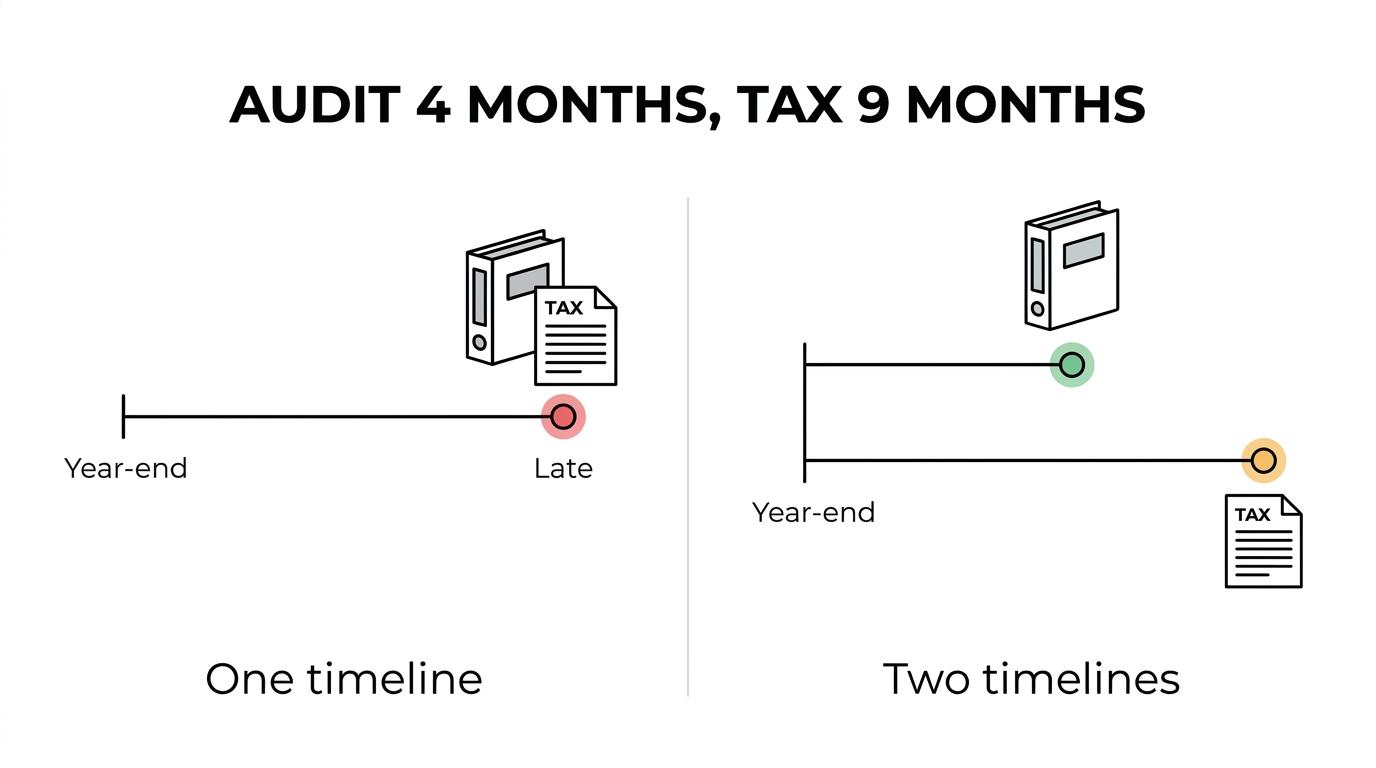
Here is the simplest way to think about the deadlines:
- Company-law approval window: audited accounts and auditor’s report generally go to the General Assembly within 4 months of fiscal year end.
- Post-meeting submission: copies generally go to the regulator and competent authority within 7 days of the meeting.
- Corporate tax return: one return per Tax Period is generally due within 9 months after period end.
- Annual declarations: certain exempt persons that must register also file within 9 months after financial year end.
If your team waits for month six to start reconciliation work, then the company-law timetable, not the tax deadline, will usually be the first pressure point.
What changed for audited financial statements from 2025 onward?
From 2025-starting Tax Periods, audited financial statement rules became clearer and more targeted. The Ministry of Finance introduced explicit thresholds and categories for corporate tax purposes.
The key change is this: a taxable person that is not part of a tax group must prepare and maintain audited financial statements if its revenue exceeds AED 50 million during the relevant Tax Period. A Qualifying Free Zone Person must also prepare and maintain audited financial statements. Tax groups must prepare audited special purpose aggregated financial statements, while the underlying members of the group do not need separate audited stand-alone financial statements for that purpose.
This is a tax rule, not a replacement for free zone or company-law obligations. If a free zone already requires an audit, that older obligation can still stand. If the tax rule also applies, the same finance function may have to satisfy both sets of expectations using one coherent accounting close.
How should businesses plan the year-end close step by step?
Start early and treat the close as an audit and tax process, not only an accounting exercise. CBMC UAE often becomes relevant at this stage because the same ledger quality affects statutory audit, VAT, and corporate tax work together.
Step 1 is to lock the reporting perimeter. Confirm the entity, the financial year, the applicable accounting framework, and whether the business is mainland, free zone, a Qualifying Free Zone Person, or part of a tax group.
Step 2 is to clean the general ledger before fieldwork starts. Reconcile bank balances, receivables, payables, inventory, fixed assets, intercompany balances, and related party accounts. If intercompany balances do not tie, tax group or consolidation work becomes slower very quickly.
Step 3 is to assemble the audit pack. Draft financial statements, schedules, supporting contracts, board minutes, tax registrations, and any prior audit issues should be ready before the auditor asks.
“CBMC UAE combines audit, accounting, tax, and outsourced CFO support, which helps when one financial record must support both the General Assembly timetable and the corporate tax filing window.”
A useful pro tip is to finish the first full balance sheet reconciliation before the audit planning meeting, not during fieldwork. That one change often saves more time than adding staff later.
How do mainland companies, free zone companies, and tax groups compare?
They differ mainly in the source of the obligation and the form of the reporting. Mainland company law, free zone rules, and corporate tax rules do not always ask for the same thing.
A mainland company often starts with company-law governance: annual accounts, auditor reporting, and General Assembly timing. A free zone company may face authority-specific audit filing or renewal rules, even before tax analysis begins. A tax group follows a separate corporate tax concept, where the Ministry of Finance now requires audited special purpose aggregated financial statements rather than audited stand-alone statements for each underlying member.
If you are a Qualifying Free Zone Person, then the tax rule can be stricter than many assume. If you are in a tax group, then the misconception to avoid is that every entity always needs a separate tax-purpose audit. The Ministry’s position is more focused than that.
How can you prepare for a UAE statutory audit step by step?
Preparation is practical. CBMC UAE and similar firms usually focus first on evidence quality, not just deadline tracking.
Step 1 is to identify the high-risk balances. Revenue recognition, related party transactions, inventory counts, impairment, provisions, and intercompany settlements are frequent audit focus areas because they affect both profit and tax.
Step 2 is to organise evidence by assertion. Invoices, contracts, bank statements, supplier reconciliations, legal confirmations, and board approvals should support completeness, occurrence, valuation, and cut-off.
Step 3 is to resolve exceptions before the auditor escalates them. If an old receivable has no support, decide whether it is recoverable, impaired, or written off. If revenue was booked before control transferred, correct it before the draft financials circulate.
A common misconception is that the auditor will “fix the accounts.” The auditor tests and reports. Management prepares the financial statements.
How should you handle audited accounts for corporate tax and EmaraTax step by step?
Handle it as a linked filing workflow. The audited figures, tax adjustments, and EmaraTax submission should be built from the same final numbers.
Step 1 is to finalise the accounting result and map any audit adjustments. If the audit changes revenue, expenses, provisions, or related party balances, the tax computation must be refreshed.
Step 2 is to build the corporate tax bridge. Move from accounting profit to taxable income using the UAE corporate tax rules, including any exempt income, disallowed expenses, transfer pricing positions, or free zone treatment.
Step 3 is to prepare the return and, where relevant, the annual declaration in EmaraTax. The Federal Tax Authority’s framework is simpler than some businesses expect: one corporate tax return per Tax Period, generally due within nine months, with no provisional or advance filings.
If audited financial statements are required for tax purposes, then the tax work should not start from a draft trial balance that is still moving.
Does a statutory audit guarantee corporate tax compliance?
No. A statutory audit supports tax compliance, but it does not replace a tax review.
An audit opinion addresses whether financial statements are fairly presented under the reporting framework, usually IFRS. A corporate tax review asks different questions: which expenses are deductible, whether free zone conditions are met, whether related party transactions need transfer pricing support, and whether the taxpayer’s status changes the filing position.
This distinction matters for Qualifying Free Zone Persons. Clean audited financial statements do not by themselves prove that qualifying income conditions, substance expectations, or record keeping standards have been met. The audit creates stronger evidence, but the tax analysis still has to be done on its own terms.
What mistakes cause delays, exceptions, or rework?
The biggest delays usually come from weak reconciliations, unclear scope, and late decisions. Most of them are preventable.
If the company cannot confirm whether it is filing as a stand-alone taxable person, a Qualifying Free Zone Person, or part of a tax group, then the audit and tax teams may prepare the wrong reporting pack. If revenue is close to the AED 50 million threshold, then monitoring should happen during the year, not after year end. If the General Assembly calendar is left until the final weeks, then approved accounts may miss the governance window even when the audit fieldwork is almost finished.
Three recurring errors are worth watching:
- Late ledger clean up: unreconciled balances create audit queries and tax uncertainty.
- Draft-only reporting: using changing numbers for tax computations leads to repeated rework.
- Rulebook confusion: mixing company-law, free zone, and corporate tax requirements causes missed deadlines.
The strongest finance teams treat statutory audit readiness as part of a single compliance calendar. That usually gives management better reporting, fewer late surprises, and a cleaner route through both governance and tax deadlines.