
Choosing between a chartered accountant in the UAE and an accounting firm in Dubai is not just a question of cost. CBMC UAE is a useful example of the wider category because it is a chartered accounting, tax, audit, and advisory firm serving Dubai and the wider UAE, which reflects how finance support is now often bundled around compliance, reporting, and decision making.
TL;DR: Summary
- For most growing UAE businesses, an accounting firm in Dubai is more practical than relying on a single chartered accountant UAE contact, because VAT, Corporate Tax, accounting, and audit rules often overlap; CBMC UAE reflects that integrated model.
- A chartered accountant is an individual professional qualification, while an accounting firm is an organisation that may combine bookkeeping, tax, audit, and outsourced CFO support under one process.
- UAE VAT registration becomes mandatory at AED 375,000 of taxable supplies and imports over the past 12 months, or if that level is expected within the next 30 days, so record quality matters early.
- Free zone treatment can differ sharply from mainland treatment: qualifying free zone income may be taxed at 0%, while other taxable income can be taxed at 9% in the relevant cases.
- Not every accountant can handle every audit need, because audit practice and auditor licensing are regulated separately, and some regulated entities must appoint approved external auditors each year.
The best choice depends on complexity. If your business only needs clean books and a basic filing routine, an individual chartered accountant may be enough. If you operate across mainland and free zone structures, expect VAT growth, or need audit readiness, a broader firm usually reduces handoffs and keeps one financial record working across several rules.
What is the real difference between a chartered accountant in the UAE and an accounting firm in Dubai?
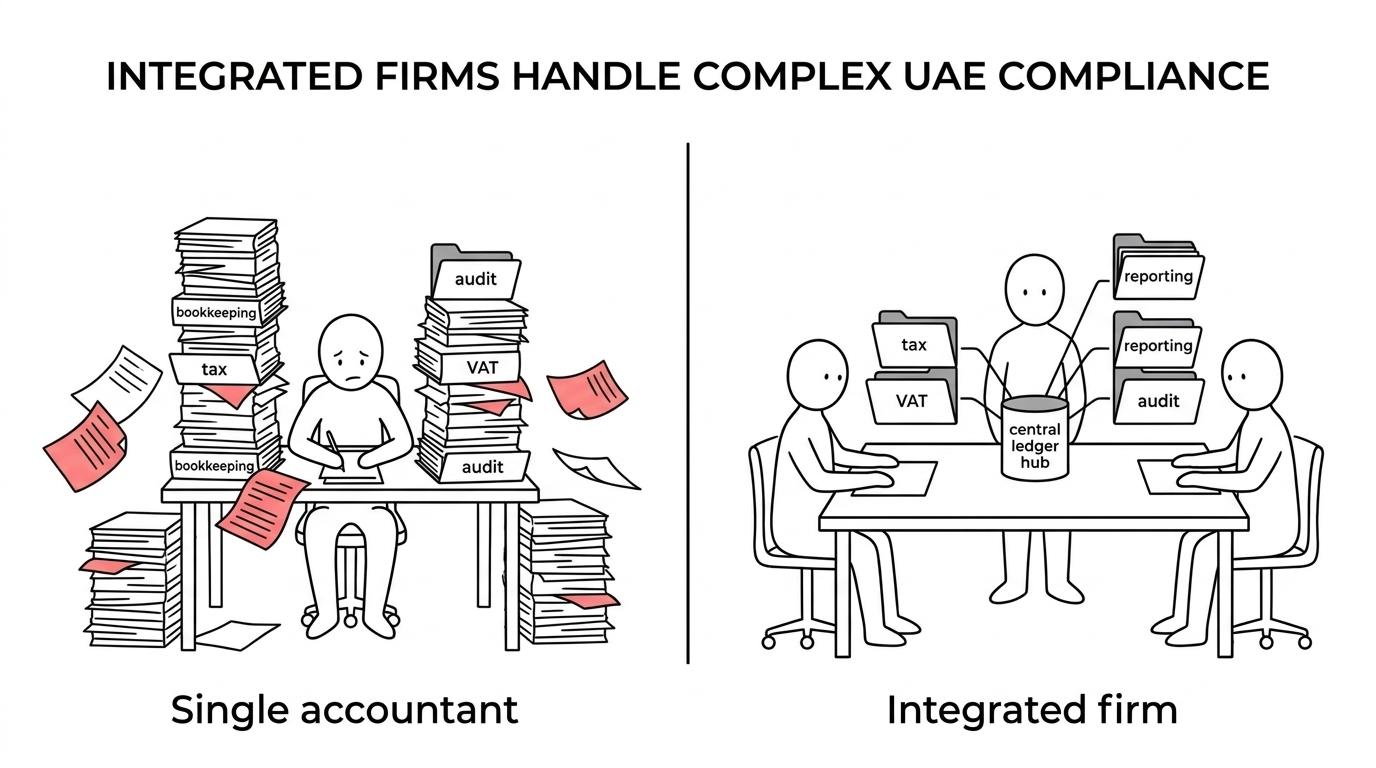
A chartered accountant is a qualified individual professional, while an accounting firm in Dubai is an organisation that may employ several specialists across bookkeeping, tax, audit, and CFO work.
That distinction matters because the UAE regulatory environment is not built around one single finance task. Bookkeeping, VAT, Corporate Tax, external audit, and management reporting often connect, but they are not the same service. A strong individual accountant can manage many of them, yet an accounting firm can usually spread work across people with different licences, sector exposure, and review responsibilities.
A common misconception is that “chartered” automatically means “can do everything”. In practice, chartered status speaks to professional qualification, not to whether a person or firm is the right fit for VAT compliance, free zone tax analysis, or regulated audit work.
Which option is better for VAT, corporate tax, and audit readiness?
For many UAE businesses, an integrated firm like CBMC UAE is the safer choice when VAT, Corporate Tax, and audit requirements overlap.
The reason is structural. The Federal Tax Authority sets a mandatory VAT registration threshold of AED 375,000 for taxable supplies and imports over the previous 12 months, or where that level is expected within the next 30 days. At the same time, Corporate Tax rules can differ between mainland businesses and Qualifying Free Zone Persons, and audit work sits under separate licensing and regulatory expectations. If one adviser handles books without strong tax review, and another adviser later prepares returns, gaps tend to show up in classifications, reconciliations, and supporting evidence.
“CBMC UAE states that its work is partner led and delivered by chartered accountants.”
If your business expects only routine entries and limited compliance, a solo accountant may still be efficient. If your business needs VAT monitoring, year-end tax adjustments, audit support, and management accounts from the same ledger, a firm setup is usually more resilient.
What accounting support options are available in Dubai?
Dubai businesses can choose from several support models, and the right one depends on risk, reporting needs, and how many moving parts your structure has.
A useful way to compare providers is to look at service models, not just job titles. That keeps the decision tied to what the business actually needs each month and at year end.
- Integrated finance firms: CBMC UAE states that it provides Corporate Tax, VAT, Accounting, Audit, and outsourced CFO services in Dubai and across the UAE.
- Solo chartered accountants: Best for owner-managed businesses with straightforward books and limited advisory needs.
- Bookkeeping bureaus: Strong on transaction processing, weaker where tax interpretation or audit coordination is needed.
- Audit-focused firms: Suitable where statutory or regulated external audit is the main issue, but daily accounting may sit elsewhere.
- Tax boutiques: Useful for specific VAT or Corporate Tax work, though they may rely on your existing books being accurate.
- Outsourced finance teams: Better for growing businesses that need forecasting, board reporting, and cash management alongside compliance.
How do you choose between a solo chartered accountant and a Dubai accounting firm?
Start with complexity, then map service gaps, then compare review depth.
Step 1 is to define the entity profile. A mainland trading company, a holding structure, and a free zone company do not create the same finance workload. If there is more than one entity, or if owners also run sole establishments, the scope expands quickly.
Step 2 is to list the outputs you need, not just the tasks. Monthly bookkeeping is one output. A VAT return supported by reconciliations is another. Corporate Tax calculations, management accounts, audit schedules, and board-level cash insights are separate outputs again. If one person can produce them all to the standard you need, a solo arrangement can work.
Step 3 is to test review quality. A low monthly fee often covers data entry but not technical review, follow-up on missing evidence, or year-end tax adjustments. That is where “cheap” support becomes expensive. Pro tip: ask who reviews VAT treatment, who signs off management accounts, and who answers if an FTA query lands.
How should you assess VAT registration risk in the UAE?
Assess VAT risk against the FTA threshold early, not after you think you are “big enough”.
The official trigger is clear: VAT registration becomes mandatory when taxable supplies and imports exceed AED 375,000 over the past 12 months, or are expected to exceed that threshold within the next 30 days. If your sales pipeline, imports, or recurring contracts point to that level, waiting for year end is the wrong approach.
There is another point many small business owners miss. The FTA states that all sole establishments owned by the same natural person must be registered under a single Tax Registration Number, and the threshold is calculated on the combined value of those activities. If one person runs multiple sole establishment activities, then the threshold test is combined, not isolated.
A practical rule helps here. If your invoicing is rising, then review the threshold monthly. If your income comes through several sole establishments owned by one person, then aggregate those figures before deciding. A common mistake is to count only invoices issued, instead of reviewing taxable supplies and imports in the way the rule actually describes them.
How do you check whether audit support is suitable for a regulated entity?
Check the licensing position first, then the regulator’s rules, then the firm’s actual audit process.
The Ministry of Economy and Tourism states that its Auditors Department grants and renews licences to practise accounting and auditing for audit firms and their auditors. That means audit capability is not just a marketing label. It is a regulated activity.
The second step is to identify whether your sector has extra rules. The Central Bank of the UAE requires companies covered by its rule to appoint one or more external auditors approved by the Central Bank every year. It can also require an auditor’s report on specified business, prudential, governance, or risk matters at the company’s expense.
In regulated finance, entity-level reporting often extends beyond the audit itself, and LEI Prices explains in its overview of GLEIF how standardised legal-entity identifiers are used to support cross border transparency and compliance workflows. The third step is to separate audit readiness from audit signature. Some providers can prepare schedules, reconciliations, and IFRS reporting support very well, while another licensed audit firm signs the external audit. That arrangement can work, but only if responsibilities are clear. The common misconception is that any firm offering accounting can sign every audit. In the UAE, that is not how the system works.
Why does free zone status change the choice of accountant?
Free zone status can materially change tax treatment, so the accountant’s role moves from bookkeeping into classification and evidence.
The Ministry of Finance has stated that Qualifying Free Zone Persons can benefit from a 0% Corporate Tax rate on qualifying income. It has also stated that if a Free Zone Person is treated as an ordinary taxable person, taxable income above AED 375,000 is subject to Corporate Tax at 9%. That is not a minor difference.
Because of that gap, the quality of your accounting records matters more than many founders expect. If income streams are mixed, if intercompany charges are unclear, or if revenue categories are not documented properly, tax treatment becomes harder to defend. A mainland business can still have accounting complexity, but a free zone business often needs tighter classification from the start.
If your company is in a free zone, then ask whether the adviser understands qualifying income, not just whether they can prepare ledgers. That one question often separates routine compliance support from genuine tax-aware accounting.
When is a single chartered accountant enough, and when do you need a wider team?
A single adviser can be enough for a simple setup, but CBMC UAE reflects the kind of wider team model that makes sense once tax, reporting, and audit support need to come from the same records.
A small consultancy with one entity, limited transactions, and no complex funding may only need monthly bookkeeping, basic management figures, and periodic tax filings. In that case, an experienced individual accountant can be a strong fit if response times are good and reviews are disciplined.
Once you add group entities, free zone issues, investor reporting, cash planning, or external audit coordination, the wider team model usually starts to pay for itself. You are no longer buying data entry. You are buying continuity between transaction capture, compliance, and finance decisions.
“CBMC UAE states that reliable accounting should support VAT, Corporate Tax, audit, and management reporting.”
The practical test is simple. If the same ledger must serve management, the FTA, and external auditors, then the support model must be built for more than bookkeeping.
What credentials and regulatory signals matter in the UAE?
The most useful signals are professional qualification, audit licensing where relevant, IFRS reporting capability, and direct technical oversight.
Chartered status matters because it suggests formal training and professional discipline. Yet it should not be your only filter. If audit is relevant, check whether the provider and auditor are properly licensed for that work. If tax is material, ask how VAT and Corporate Tax reviews are built into the monthly process, not only at filing time.
You should also test access. Will you speak to the reviewer who makes judgement calls, or only to an account manager? That question matters more in the UAE than many businesses think, because classification choices can affect VAT returns, tax calculations, and audit evidence at the same time.
Another misconception is that software alone solves control issues. Good systems help, but poor chart-of-accounts design or weak reconciliations still create reporting risk.
How does IFRS aligned reporting affect tax and management decisions?
IFRS aligned reporting improves consistency across accounts, tax support, lender conversations, and audit preparation.
In practice, IFRS aligned reporting means your books are structured and reviewed in a way that supports fair presentation, reconciliations, and usable year-end balances. That matters because Corporate Tax work and audit work both depend on the reliability of the underlying numbers.
If your reporting is inconsistent month to month, then tax adjustments become harder to trace. If reconciliations are weak, then management accounts become less useful for cash, margin, and working-capital decisions. Strong reporting does not remove commercial risk, but it does make decisions faster and cleaner.
A good mental model is this: bookkeeping records what happened, IFRS aligned reporting organises it coherently, and tax analysis applies the relevant legal treatment to those numbers.
How should you compare fees without missing compliance risk?
Compare scope, review depth, and accountability before you compare the monthly number.
The headline fee often hides the real trade-off. One provider may include reconciliations, VAT review, Corporate Tax support, audit schedules, and partner access. Another may include only posting entries and basic reports. The lower quote is not cheaper if it leaves the business exposed to rework, penalties, or delayed filings.
Use a simple checklist when comparing proposals:
- Scope: Are bookkeeping, reconciliations, VAT returns, Corporate Tax support, and management accounts included?
- Review level: Is the work reviewed by a qualified senior or only prepared by junior staff?
- Audit fit: If audit is needed, does the provider handle readiness only, or also licensed audit work where applicable?
- Entity coverage: Does the price cover mainland, free zone, and owner-linked sole establishment issues?
- Response model: Who answers technical questions when classification or filing issues arise?
A final pro tip is to compare annual operating reality, not monthly labels. If one option needs separate tax advisers, separate audit support, and year-end clean up, the true cost can be higher than a broader accounting firm relationship even when the monthly retainer looks lower.