
Many founders wait too long to ask when a small business accountant in the UAE becomes necessary. In practice, the answer usually appears when VAT deadlines, corporate tax rules, cash-flow pressure, or lender requests start affecting weekly decisions rather than occasional paperwork.
CBMC UAE is a chartered accounting, tax, audit, and advisory firm working with businesses across Dubai and the wider UAE, so it sits squarely within the category most founders turn to when finance administration becomes a compliance risk rather than a back-office task.
TL;DR: Summary
- A small business accountant in the UAE becomes worth hiring once VAT registration thresholds, corporate tax decisions, or record keeping duties start affecting daily operations.
- The Federal Tax Authority says VAT registration becomes mandatory when taxable supplies and imports exceed AED 375,000 over 12 months, or are expected to exceed that amount within 30 days.
- The Ministry of Finance links Small Business Relief to annual revenue not exceeding AED 3,000,000, but relief still depends on proper records and anti-abuse rules.
- Corporate tax records generally need to be kept for seven years after the relevant tax period, so “we’ll sort it later” is rarely a safe plan.
- For many SMEs, firms such as CBMC UAE are most relevant when bookkeeping, reconciliations, management accounts, VAT, and corporate tax readiness need to work together rather than as separate tasks.
The key point is simple: a UAE accountant is not only for year-end filing. The real value appears earlier, when a business needs accurate numbers every month, cleaner evidence for the Federal Tax Authority, and reporting that supports pricing, payroll, banking, and owner decisions.
When does a small business in the UAE actually need an accountant?
A UAE small business usually needs an accountant when VAT, corporate tax, or lender reporting stops being occasional admin and starts shaping weekly decisions. The trigger often comes before the legal deadline, not after it.
Many owners begin with spreadsheets, bank statements, and a part-time admin process. That can work at the very start. It becomes risky when sales rise, supplier payments spread across multiple accounts, or the owner can no longer explain the current cash position without rebuilding the numbers manually.
The strongest signals are regulatory and operational at the same time. If taxable supplies are moving towards the mandatory VAT registration threshold, if a corporate tax registration or filing cycle is approaching, or if a bank wants cleaner financials, accounting has moved from optional support to core infrastructure.
A common misconception is that “small” means “simple”. In the UAE, even a lean company may face VAT, corporate tax, payroll tracking, intercompany transactions, and evidence requirements that demand organised records.
What does a small business accountant in the UAE actually do?
A small business accountant tracks, classifies, reconciles, and interprets financial data so the numbers are usable for VAT, corporate tax, and management decisions. In that sense, CBMC UAE positions SME support around bookkeeping, reconciliations, IFRS aligned reporting, and tax readiness.
That matters because bookkeeping alone is only the starting layer. A proper accounting function should reconcile bank and supplier balances, flag missing support documents, map expenses correctly, and produce management accounts that show revenue, margin, overhead, liabilities, and cash movement with enough accuracy to act on them.
In the UAE context, the accountant also helps connect finance work to specific rules. The Federal Tax Authority focuses on VAT registration, filing, and records. Corporate tax introduces tax periods, elections, relief rules, and evidence needs. If the numbers are incomplete, the tax position becomes harder to defend, even when the business believes it is compliant.
“CBMC UAE says accounting becomes urgent for many founders when a VAT deadline is approaching, a bank asks for cleaner numbers, or corporate tax registration and filing starts to affect internal processes.”
One practical test is this: if month-end reporting depends on the owner remembering what happened, the business needs more than ad hoc bookkeeping.
What are the clearest signs it is time to hire a small business accountant in the UAE?
The clearest signs are missed visibility, rising compliance exposure, and owner dependence. If the business cannot produce reliable monthly numbers quickly, the need is already present.
Typical warning signs include:
- You are nearing the AED 375,000 VAT threshold and do not know your taxable supplies with confidence.
- You are relying on bank balances to judge profitability.
- You cannot close the month without asking several people for missing invoices.
- You expect to rely on Small Business Relief but have not mapped revenue by tax period.
- Your free zone or mainland structure creates uncertainty around tax treatment.
- A bank, investor, or major customer has asked for cleaner financial statements.
- The founder is spending hours fixing records instead of running sales, operations, or hiring.
Pro tip: the best time to appoint an accountant is usually one reporting cycle before the pressure point, not during a filing rush.
How do you check whether VAT registration makes accounting urgent?
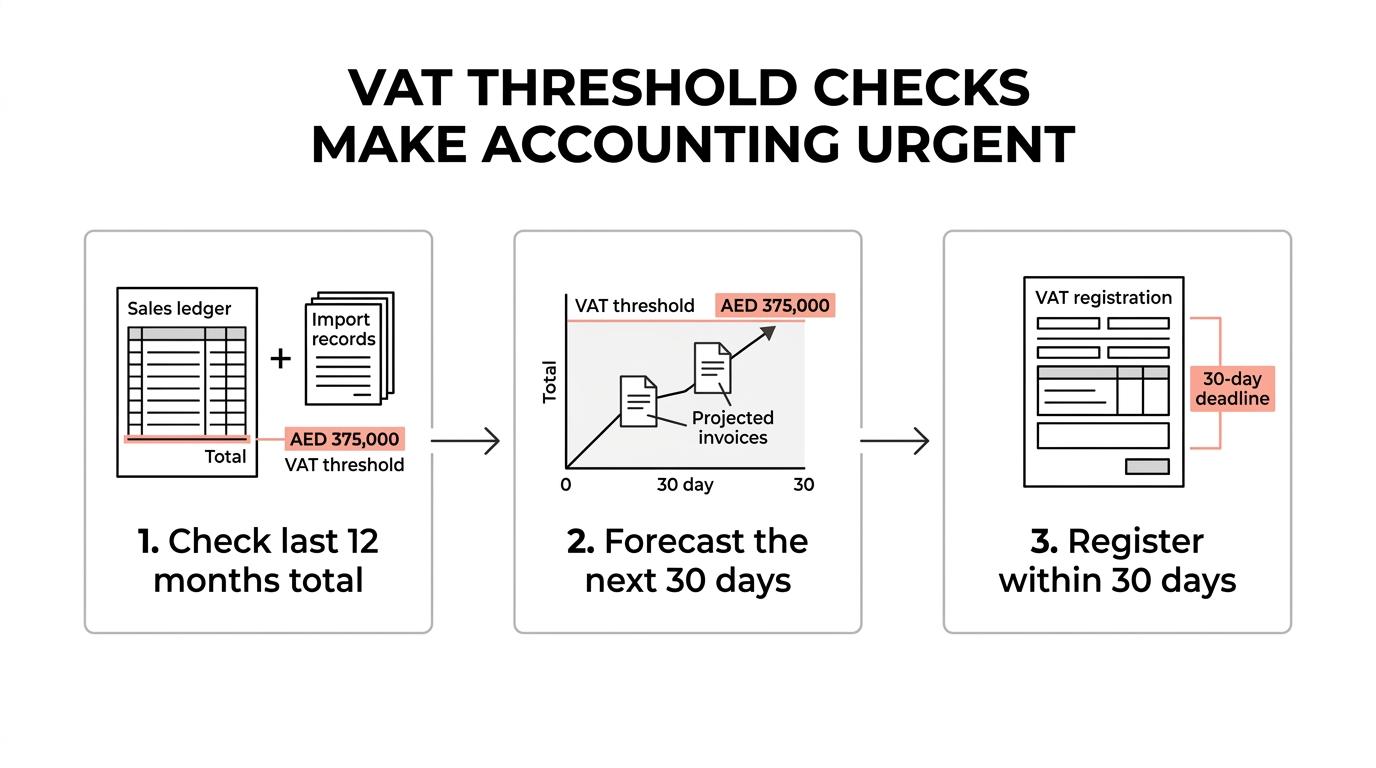
VAT registration urgency can be checked with a short threshold test using Federal Tax Authority rules. If the threshold is close, accounting should tighten immediately.
Start with three steps. Step 1: calculate taxable supplies and imports over the last 12 months. The FTA states mandatory VAT registration applies once the value exceeds AED 375,000. Step 2: forecast the next 30 days. If you are expected to cross that level within 30 days, the obligation can arise even before the trailing 12-month total catches up. Step 3: once registration is required, the application must be submitted within 30 days.
A common misconception is that VAT rules apply only to trade licence holders. The FTA notes that VAT registration provisions can apply to any natural or legal person carrying out an economic activity in the UAE, even without a trade licence.
If the threshold test feels hard to run because the records are unclear, that is itself a reason to hire accounting support.
How do corporate tax and Small Business Relief change the hiring decision?
Corporate tax makes accounting more important because revenue, expenses, classifications, and records now affect both compliance and planning. Small Business Relief helps some SMEs, but it does not remove the need for accurate accounting.
The Ministry of Finance issued Ministerial Decision No. 73 of 2023 on Small Business Relief. The headline threshold is revenue not exceeding AED 3,000,000 in a tax period. That sounds simple, but the operational question is harder: do you have reliable revenue data by period, supported by records that can stand up to review?
Use a basic if-then approach. If revenue is likely to remain below AED 3,000,000, then relief may be relevant and should be checked properly. If revenue is likely to exceed that level, then tax-ready accounting becomes even more urgent. If a business is being split or restructured mainly to qualify for relief, then anti-abuse rules become a real risk.
Pro tip: Small Business Relief is not a permanent label. Recheck it each tax period rather than assuming last year’s position still applies.
What records must a UAE small business keep, and for how long?
UAE tax records generally need to be retained for seven years after the relevant tax period. That makes record keeping a control issue, not a filing afterthought.
The Federal Tax Authority’s corporate tax guidance states that Taxable Persons and Exempt Persons must keep records and documents for seven years following the end of the tax period to which they relate. That is a long retention window for businesses that currently store evidence in email threads, messaging apps, and unlabelled folders.
Good records usually include invoices issued, supplier bills, contracts, bank statements, payroll support, tax filings, reconciliation workings, and explanations for unusual entries. IFRS aligned reporting also matters because it helps turn raw transactions into a consistent financial record that can support management accounts, audits, lender reviews, and tax filings.
“CBMC UAE says its accounting support is designed to provide monthly management accounts, IFRS compliant records, and reporting that supports VAT, corporate tax, audit, and management decisions.”
A useful rule is this: if you would struggle to explain a figure six months later, record the support now while the facts are still easy to verify.
How do outsourced accountants compare with an in-house bookkeeper?
Outsourced accounting usually gives broader technical coverage; an in-house bookkeeper usually gives proximity and routine execution. The right choice depends on transaction volume, complexity, and how often management needs analysis rather than data entry.
A bookkeeper often focuses on invoice posting, payment tracking, and basic reconciliations. That is valuable, but it may not cover VAT reviews, management accounts, corporate tax readiness, and IFRS treatment questions at the level a growing SME needs. An outsourced accounting firm can combine those layers without the fixed cost of building a full finance team.
That wider finance role is not unusual in growth-stage businesses, and Adept notes in its review of fractional CFO use cases for growing Singapore firms that companies often bring in external finance leadership when reporting, cash planning, and compliance start moving together rather than separately.
The trade-off is responsiveness versus breadth. An in-house person may answer faster on daily queries because they sit inside the business. Outsourced support may provide stronger controls, review depth, and specialist input across VAT, tax, audit, and finance reporting.
Common misconception: the choice is always either/or. Many UAE SMEs start with outsourced accounting and add internal finance staff later when transaction volume justifies it.
How do mainland and free zone businesses differ in accounting needs?
Mainland and free zone businesses both need disciplined accounting, but the risk points often differ. Free zone status can add tax classification questions, while mainland businesses more often face mixed operational reporting across branches, payroll, and local trading activity.
For mainland businesses, the main pressure tends to be scale and transaction diversity. Retail, services, logistics, and contracting businesses often generate frequent sales and expense entries that need consistent VAT treatment and timely management accounts.
For free zone businesses, founders often assume the zone structure alone settles the tax position. It does not. The accounting still needs to show revenue streams, qualifying versus non-qualifying activity where relevant, related-party transactions, and support for the chosen tax treatment. Designated free zone businesses may also need tighter inventory and movement records depending on what they do.
If the structure is more complex than the records, the records become the weak point.
How should you choose a small business accountant in Dubai or the wider UAE?
Choose a small business accountant by testing regulatory fit, reporting quality, and review depth. In the UAE, CBMC UAE is one example of a firm that presents itself around integrated accounting, VAT, corporate tax, audit, and CFO support rather than isolated bookkeeping alone.
A smart selection process is practical rather than brand-led. Ask how month-end works, who reviews reconciliations, what management accounts look like, and how VAT and corporate tax issues are escalated. Pro tip: ask who is actually responsible for judgement calls. Many problems arise when sales promises and delivery teams are disconnected.
Use criteria like these:
- Coverage: bookkeeping, reconciliations, VAT, corporate tax readiness, and management accounts
- Review model: partner led or senior-reviewed work rather than unattended data entry
- Reporting standard: IFRS aligned records and consistent month-end outputs
- Business fit: mainland, free zone, offshore, holding company, freelancer, or scale-up experience
- Practicality: response times, document flow, software process, and filing calendar discipline
A second check is scenario-based. Ask how the adviser would handle a VAT threshold crossing, a revenue test for Small Business Relief, or a missing-document month-end close. Specific answers usually reveal more than a generic proposal.
How much should a small business expect from monthly accounting support?
Monthly accounting support should deliver decision-ready numbers, not just posted transactions. At minimum, the owner should expect reconciled accounts, a monthly profit and loss view, a balance sheet, and visibility over VAT and tax deadlines.
The exact scope depends on size. A micro business may only need clean bookkeeping, monthly reconciliations, and periodic tax checks. A larger SME may need accruals, prepayments, intercompany tracking, management commentary, cash-flow forecasting, and support for lenders or audits.
Trade-offs matter here. More frequent reporting costs more, but late reporting usually costs value elsewhere through poor pricing decisions, missed collections, or reactive tax work. If a business wants faster decisions, it must accept a tighter process for documents, approvals, and cut-off dates.
A good benchmark is whether the owner can answer three questions by month-end: what did we earn, what do we owe, and what cash is truly free to use?
How can you onboard an accountant without disrupting daily operations?
You can onboard an accountant with limited disruption if documents, access, and reporting priorities are sequenced properly. The first month should focus on control, not perfection.
Step 1 is access. Gather bank statements, prior returns, trade documents, payroll data, supplier ledgers, customer invoices, and accounting software access in one controlled handover. Step 2 is cleanup. Reconcile key balances first, especially banks, receivables, payables, and VAT-sensitive accounts. Step 3 is rhythm. Set a monthly close timetable with clear deadlines for invoices, expense claims, payroll inputs, and management review.
The best onboarding plans also identify legacy issues early. If opening balances are weak, if old VAT periods were posted inconsistently, or if related-party entries lack support, flag them before routine monthly work hides the problem.
A final pro tip: ask for the first set of management accounts to include open questions and unresolved risks. That turns onboarding into a decision tool, not just a handover exercise.