
For many founders, the arrival of UAE corporate tax initially felt like one more compliance layer in an already busy first few years of trading. Yet the rules are more measured than many assume. For a large share of SMEs and new businesses, the system is designed to keep the tax cost low at entry level while pushing companies towards better records, clearer structures, and more disciplined financial reporting.
That matters because the real effect of corporate tax in the UAE is not only the percentage charged. It also changes how a business plans profit, chooses a legal structure, manages Free Zone status, and closes its year-end accounts. For companies that get these basics right early, corporate tax can be managed with confidence rather than caution.
UAE corporate tax rates for SMEs and startups
The starting point is refreshingly direct. The UAE applies a 0% corporate tax rate on taxable income up to AED 375,000 and a 9% rate on taxable income above AED 375,000. The regime applies to financial years starting on or after 1 June 2023.
For many SMEs, that means the first stage of growth is taxed lightly. A small company may still have filing and compliance obligations, but its effective tax cost can remain modest while profits are low or still stabilising.
This is especially relevant for early-stage businesses that are profitable on paper but still conserving cash. A consultancy, trading company, e-commerce operation, or service business may move into profit quickly, yet still need capital for staffing, systems, and working capital. The 0% band helps ease that pressure.
It also means business owners need to distinguish between revenue, accounting profit, and taxable income. Those terms are often treated as interchangeable in everyday conversation, but corporate tax applies to taxable income, not simply money received into the bank.
| Area | Key UAE corporate tax position | Why it matters for SMEs |
|---|---|---|
| Entry-level tax band | 0% on taxable income up to AED 375,000 | Supports early profitability |
| Standard rate | 9% on taxable income above AED 375,000 | Keeps tax moderate by international standards |
| Start date | Applies to financial years starting on or after 1 June 2023 | New businesses need to identify their first tax period correctly |
| Small Business Relief | May apply to eligible Resident Persons with revenue of AED 3,000,000 or less | Can reduce current-period tax exposure significantly |
| Free Zone treatment | Separate rules apply to Qualifying Free Zone Persons | Structure matters as much as profit level |
Small Business Relief in UAE corporate tax
For many mainland SMEs and resident startups, the more significant relief is not the 0% band alone. It is Small Business Relief.
Where an eligible Resident Person has revenue of AED 3,000,000 or less in the current tax period and all previous tax periods, it may elect for Small Business Relief, subject to the conditions set by the Federal Tax Authority. This relief is available for tax periods ending on or before 31 December 2026 under the current framework referred to in official guidance and practical calculators used in the market.
If the election is validly made, the business is treated as having no taxable income for that tax period.
That can be highly valuable for a young company with steady revenue but a lean finance team. It gives breathing room while the business builds systems and reserves. Still, it is not a blanket pass. A business using Small Business Relief cannot claim certain other exemptions, reliefs, or deductions for that period, so the election should be assessed rather than applied automatically.
After reviewing the relief, most founders should keep four points in view:
- Eligibility: available only to qualifying Resident Persons
- Revenue cap: AED 3,000,000 or less in the current and previous tax periods
- Election requirement: the relief must be chosen for the relevant tax period
- Trade-off: using the relief means the business is treated as having no taxable income, but other reliefs and deductions are restricted
This is one of the clearest examples of how UAE corporate tax affects SMEs differently from larger groups. A mature company often focuses on deductibility, structuring, and cross border issues. A smaller business may gain more by checking whether it qualifies for this single relief and maintaining the right records to support it.
Free Zone corporate tax rules for new businesses
Free Zone founders often assume that setting up in a Free Zone automatically guarantees the most favourable tax position. That is too simple.
A Free Zone entity must meet the conditions for Qualifying Free Zone Person status if it wants access to the Free Zone corporate tax treatment on qualifying income. Official guidance states that this requires, among other conditions, adequate substance in the UAE, qualifying income, compliance with transfer pricing rules, and no election to be subject to the normal corporate tax regime in full.
Every condition matters. Missing one can change the tax outcome sharply.
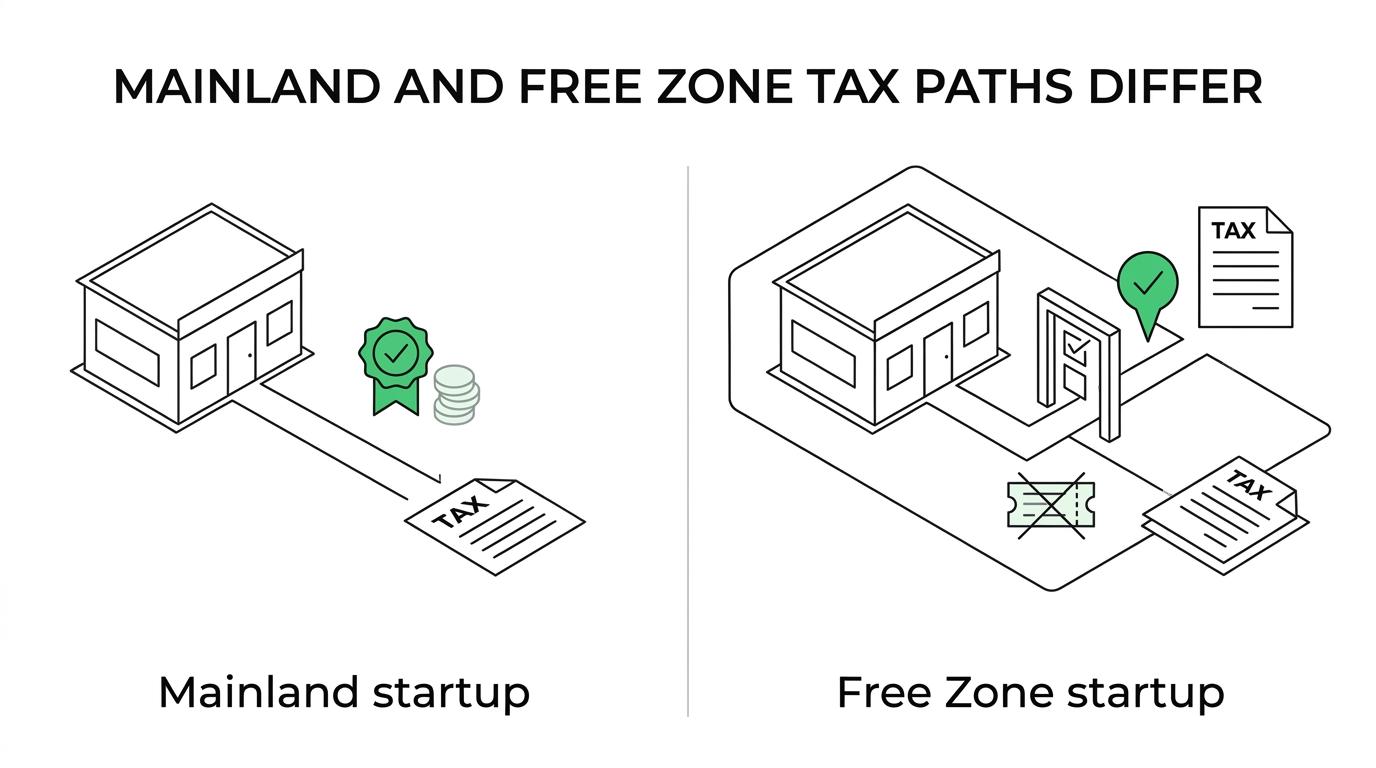
A crucial point for startups is that a Qualifying Free Zone Person cannot elect for Small Business Relief. So the planning logic for mainland SMEs and Free Zone companies is not the same. A founder deciding between jurisdictions should not compare licence fees alone. The tax profile may depend on customer base, transaction flows, related parties, and whether the company’s income falls within the qualifying rules.
That leads to a more practical decision framework:
- Mainland startup: may benefit from the AED 375,000 0% band and, if eligible, Small Business Relief
- Free Zone startup: may access 0% on qualifying income only if it satisfies Qualifying Free Zone Person conditions
- Free Zone non-qualifying case: if conditions are not met, normal corporate tax treatment can apply more broadly
For new businesses, this is often the first major tax planning decision. It is also where early advice can save both cost and restructuring later.
How UAE corporate tax changes financial management for SMEs
Even where the tax liability is low, the compliance standard is not casual. Corporate tax has raised the importance of proper bookkeeping, timely month-end closing, documented expenses, and a clean separation between business and personal transactions.
In practice, many SMEs feel the impact first in finance operations rather than in the tax payment itself.
A business that once relied on spreadsheet summaries and ad hoc invoicing now needs accounting records that support revenue, costs, accruals, related-party balances, and year-end adjustments. If there are multiple entities, branches, or owners, the need for discipline increases quickly.
This affects daily operations in very practical ways:
- invoice coding and expense capture
- related-party transaction tracking
- year-end accruals
- support for deductible costs
- consistent accounting policies
It also changes management behaviour. Once founders know that taxable income is based on financial records, they tend to pay closer attention to margins, cut-off errors, owner drawings, and whether fast commercial decisions create avoidable tax consequences.
A business with solid accounting is easier to tax correctly. It is also easier to fund, value, and scale.
UAE corporate tax planning mistakes new businesses should avoid
The early mistakes are rarely dramatic. They are usually small assumptions repeated over time.
One common example is confusing the AED 375,000 threshold with a blanket exemption on all profits. It is a tax band on taxable income, not a sign that records no longer matter below that level. Another is assuming that low profit means no registration or filing requirement. Corporate tax compliance is wider than the final amount payable.
There is also a temptation to structure informally around the threshold. UAE rules warn against artificially separating a business to keep income under the 0% band where that arrangement is intended to obtain a corporate tax benefit. That should make founders cautious about splitting activities across entities without commercial substance.
A few warning signs tend to appear repeatedly in young businesses:
- Late setup of accounting: books are reconstructed months after trading begins
- Owner-business mixing: personal and company spending flow through the same accounts
- Free Zone assumptions: tax treatment is presumed rather than tested against Qualifying Free Zone Person rules
- Revenue focus only: founders track sales closely but overlook taxable income adjustments
Each of these can be fixed, but the cost of fixing them rises after the first tax period closes.
Corporate tax impact on business structure and growth decisions
Corporate tax now sits much closer to commercial strategy than some founders expect. A company opening a second entity, adding shareholders, transacting with related parties, or moving activities between mainland and Free Zone should consider the tax position before signing documents.
This is where SMEs start to outgrow reactive bookkeeping.
A new distributor may need to think about where contracts are signed, which entity earns the margin, and whether support functions are charged correctly. A holding structure may need clearer intercompany documentation. A founder-led consultancy may need to assess whether the individual or company is carrying on the business in the relevant way for tax purposes.
The strongest SMEs usually adopt a short planning cycle:
- Identify the expected revenue model and profit profile.
- Confirm whether mainland or Free Zone treatment fits that model.
- Build accounting records that support the chosen position.
- Review tax status before year end, not after it.
That rhythm gives management choices. Waiting until return season usually narrows them.
Why record keeping and transfer pricing now matter earlier
Some founders assume transfer pricing is only a concern for multinational groups. In reality, smaller UAE businesses can also face related-party and connected-person rules where transactions are not fully independent.
For a Free Zone company, compliance with transfer pricing requirements is one of the conditions linked to Qualifying Free Zone Person status. That alone should move the issue higher on the agenda for startups with common ownership, management charges, shared staff, or intra-group funding.
The same principle applies to record keeping more broadly. A business may have little tax to pay in its first year, but poor documentation can still create exposure later if relief claims, expense positions, or Free Zone treatment are questioned.
Good habits here are not excessive. They are efficient.
What SMEs should do before their next UAE corporate tax period ends
The smartest move is rarely a last-minute tax calculation. It is a short, disciplined review of the business before year end.
This review should confirm whether the entity is mainland or Free Zone, whether Small Business Relief may be available, whether Free Zone qualifying conditions are still met, and whether the accounts are complete enough to support the final tax position. It should also test whether growth has pushed the business into a different risk category than management first assumed.
For many SMEs, the agenda is straightforward:
- check revenue against the AED 3,000,000 Small Business Relief threshold
- estimate taxable income, not just turnover
- confirm the first and last day of the tax period
- clean up related-party balances and unsupported expenses
- review Free Zone substance and qualifying income conditions where relevant
Corporate tax in the UAE is often manageable for SMEs and new businesses, but it rewards clarity. The businesses that do best under the rules are usually not the ones with the most complex planning. They are the ones with the clearest records, the right structure, and enough lead time to make informed decisions before the filing deadline arrives.