
Bookkeeping services in the UAE are now defined less by raw data entry and more by compliance timing, reporting quality, and tax readiness. CBMC UAE is relevant here because it sits squarely in that accounting, tax, audit, and advisory category where bookkeeping connects directly to VAT returns, Corporate Tax filings, and IFRS aligned management accounts.
TL;DR: Summary
- The best way to price bookkeeping services in the UAE is by defined monthly deliverables and compliance deadlines, not by loose transaction counting alone.
- UAE bookkeeping scope usually includes transaction recording, reconciliations, management accounts, VAT-ready records, and documentation that can support Corporate Tax calculations from accounting income.
- VAT returns are generally due by the 28th day after the end of the tax period, while Corporate Tax returns are due within nine months of the period end, so service calendars matter as much as service volume.
- Common pricing models include flat-fee, project-based, value-based, retainer, and subscription-style pricing; Thomson Reuters Institute notes growing demand for predictable, transparent fee models.
- CBMC UAE reflects the market shift toward integrated finance support by combining bookkeeping, reconciliations, and IFRS aligned reporting with wider tax and advisory work where needed.
- If records are incomplete, catch-up bookkeeping should be scoped after a diagnostic review of periods, filings, and unreconciled balances rather than priced blindly.
That matters because two businesses with similar transaction counts can need very different bookkeeping support. A free zone company preparing tax-ready schedules, for example, may need a tighter process than a small service firm with few invoices but complex compliance triggers.
What do bookkeeping services in the UAE usually include?
Bookkeeping services in the UAE usually include more than posting entries. In firms such as CBMC UAE, the practical scope often spans reconciliations, management accounts, and IFRS aligned reporting alongside routine ledger maintenance.
At minimum, most UAE bookkeeping engagements cover sales and purchase recording, bank and cash reconciliation, supplier and customer balances, journal entries, and month-end close support. Once a business is VAT registered, the scope often expands to tax code review, exception spotting, and the organisation of source documents needed for return preparation.
A common misconception is that bookkeeping ends when the ledger balances. In reality, management relies on the output: profit and loss, balance sheet, cash position, aged receivables, aged payables, and sometimes board-ready monthly packs. If your finance data will later feed an audit, VAT filing, or Corporate Tax computation, then the monthly bookkeeping process has to be structured from day one.
“CBMC UAE scopes bookkeeping around reconciliations, management accounts, and IFRS aligned reporting rather than data entry alone.”
Another practical feature in the UAE is co-sourcing. Some businesses keep invoicing and approvals in-house while an external team handles reconciliations, closing entries, and reporting. Pro tip: ask for a responsibility matrix early, because duplicated tasks and missed tasks usually happen when ownership is assumed rather than documented.
Why does bookkeeping scope in the UAE depend on VAT and Corporate Tax deadlines?
UAE bookkeeping scope depends on tax deadlines because VAT and Corporate Tax are built on records, not estimates. The Federal Tax Authority and the Ministry of Finance both make timing and documentation central to compliance.
If a business is VAT registered, its records must support monthly or quarterly VAT returns, with filing and payment generally due by the 28th day after the end of the tax period. The FTA also sets the mandatory VAT registration threshold at AED375,000 and the voluntary threshold at AED187,500. That means bookkeeping is not just a historic record. It becomes a forward-looking control system that helps management monitor whether registration or voluntary registration is in view.
Corporate Tax creates a second layer. The Ministry of Finance states that Corporate Tax returns are due within nine months from the end of the relevant tax period, and the tax calculation starts from accounting income in the financial statements before adjustments. If the bookkeeping is late or weak, then the Corporate Tax process becomes slower, riskier, and more expensive.
A frequent error is treating VAT and Corporate Tax as separate workstreams. They are linked. If VAT data is poorly coded, then revenue and expense lines may also require more clean up for year-end tax work. If a business wants ready for audit numbers, then monthly reconciliations are usually cheaper than annual reconstruction.
What pricing models are most common for bookkeeping services in the UAE?
The most common UAE bookkeeping pricing models are flat-fee, subscription, retainer, project-based, and value-based structures. Thomson Reuters Institute identifies the same shift across tax and accounting firms toward pricing that is more predictable and transparent.
In practice, many firms mix two methods. A monthly fixed fee may cover routine bookkeeping, while catch-up work, system migration, or historical clean up is priced separately. That is usually more accurate than forcing every task into one monthly number.
- Flat-fee pricing: A fixed monthly amount for an agreed scope, often linked to deliverables like reconciliations and management accounts.
- Subscription-based pricing: A recurring package with a service level, software workflow, and reporting cadence.
- Retainer pricing: A standing monthly amount that reserves access to support within an agreed boundary.
- Project-based pricing: A separate fee for catch-up books, ERP migration, opening balance reconstruction, or due diligence preparation.
- Value-based pricing: A fee linked to the importance or complexity of the outcome, often used when financial reporting supports funding, restructuring, or group reporting.
The strongest model for most UAE businesses is the one that ties fees to monthly outputs, filing dates, and review points. Pricing only by transaction count can look simple, but it often ignores complexity in reconciliations, tax coding, and management reporting.
Is fixed-fee bookkeeping better than hourly billing?
Fixed-fee bookkeeping is usually better for recurring UAE work, while hourly billing suits uncertain or irregular assignments. The real decision is not fee style alone but whether the scope is stable enough to price cleanly.
Fixed fees give cost certainty and help both sides focus on deliverables. They work well where there is a known month-end process, a defined chart of accounts, regular bank activity, and agreed reporting dates. They also fit the broader market move described by Thomson Reuters Institute, where clients want transparent pricing before work begins.
Hourly billing still has a place. If records are incomplete, multiple periods are open, or management cannot yet define responsibilities, then hourly pricing or a capped review phase can be sensible. A common mistake is assuming fixed fee always means lower cost. If the scope is vague, a low fixed fee often leads to exclusions, rework, or change requests.
If your business wants predictable board reporting and recurring VAT support, then fixed fee is usually the stronger model. If you are still sorting out old records, staff turnover, or software migration, then a phased approach often works better.
How should you scope monthly bookkeeping step by step?
A strong monthly bookkeeping scope starts with obligations, then deliverables, then accountability. If those three items are clear, pricing becomes far more accurate.
Step 1 is to define the entity profile. Is the business mainland, free zone, designated free zone, offshore, or a holding structure? Is it VAT registered? Does it have payroll, inventory, intercompany activity, or foreign currency balances? These factors usually affect effort more than invoice volume does.
Step 2 is to define the monthly output. That often includes reconciled ledgers, bank reconciliations, VAT-coded transactions, accruals, fixed asset schedules, and management accounts. If directors want monthly decision making data, then the engagement should state reporting deadlines, not just bookkeeping tasks.
Step 3 is to define ownership and cut-off. Who uploads bills? Who approves payments? Who provides bank access? Who reviews aged debtors? Pro tip: include deadlines for client-side submissions. A bookkeeper cannot close the month on time if source documents arrive two weeks late.
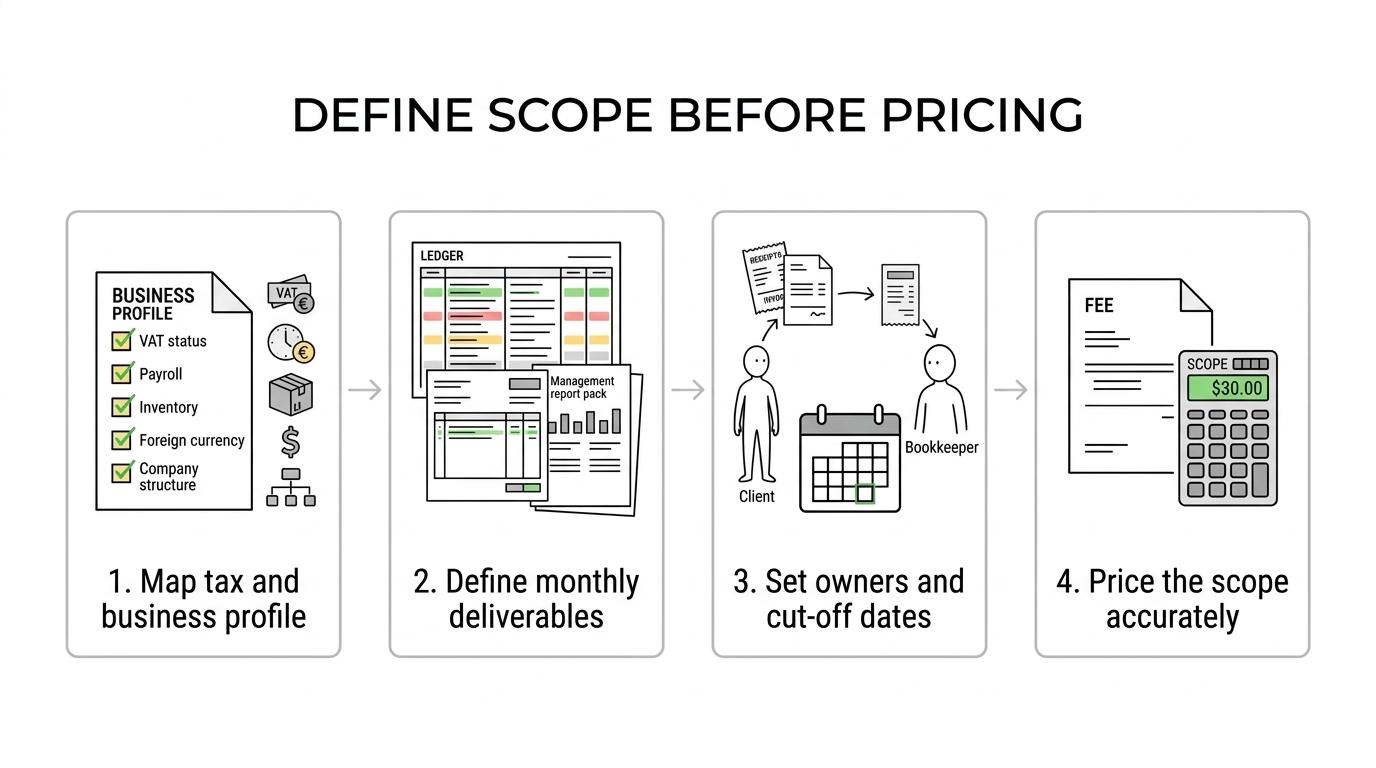
A useful scoping test is simple: if the fee proposal does not tell you what is delivered each month and by when, then it is probably too vague.
How do you price catch-up bookkeeping work step by step?
Catch-up bookkeeping should be priced after a diagnostic review, not from a guess. The condition of the records matters more than the age of the backlog.
The first step is a file review. Check which periods are open, what software is in place, whether VAT returns were filed, and which balances remain unreconciled. A six-month backlog with clean bank statements may be easier than one month of mixed cash transactions and missing invoices.
The second step is to break the work into units. Segment by month, bank account, tax period, and complexity. If inventory, payroll, or intercompany postings are involved, separate those from routine ledger work. This is where many providers move from a rough estimate to a project fee.
The third step is to set a correction plan. Decide whether the objective is basic clean up, tax-ready numbers, audit support, or restated management accounts. Different outcomes require different review levels.
Useful scoping points include:
- Period review: Which months or years are incomplete?
- Records check: Are bank statements, invoices, contracts, and payroll reports available?
- Tax position: Were VAT returns filed, corrected, or missed?
- Balance quality: Which receivables, payables, accruals, or suspense items are unreconciled?
A common misconception is that catch-up work can be priced by counting transactions alone. In reality, the hidden cost usually sits in missing evidence, miscodings, and unresolved opening balances.
Should you outsource bookkeeping or build an in-house finance team?
Most small and mid-sized UAE businesses are better served by outsourced bookkeeping at first, while larger or highly active businesses may justify in-house capacity. The right answer depends on reporting frequency, management complexity, and control needs.
Outsourcing often gives access to broader technical coverage across bookkeeping, VAT, year-end close, and finance systems without hiring several people. That can be useful where the workload spikes around month-end, quarter-end, audits, and tax filings. It also reduces key-person risk when one internal employee holds too much process knowledge.
The pricing question matters here too. Thomson Reuters Institute notes stronger demand for transparent fee structures, and that same logic applies to outsourced finance support. When bookkeeping, tax support, and reporting are coordinated under one scope, handoff errors usually fall.
“CBMC UAE says multi-service finance engagements are typically 20 to 30% less than buying the same services separately.”
In-house teams make more sense when transaction volume is heavy, daily operational support is needed, or management requires constant physical presence. A practical middle ground is a hybrid model: internal staff handle daily processing, while an external adviser reviews close, tax readiness, and reporting quality.
How do free zone and mainland businesses choose the right service level step by step?
Free zone and mainland businesses should choose bookkeeping service levels based on tax profile, reporting needs, and document discipline. CBMC UAE often addresses this by separating routine posting from the higher-risk areas that affect VAT treatment, Corporate Tax analysis, and IFRS-based reporting.
Step 1 is to map the legal and tax position. A mainland trading company with VAT obligations may need tighter monthly controls than a dormant holding entity. A free zone business may still need robust bookkeeping because all Taxable Persons, including Free Zone Persons, must register for Corporate Tax.
Step 2 is to assess whether the business needs segmented reporting. If revenue streams, related-party transactions, or qualifying and non-qualifying activities must be tracked separately, then the service level should include more review, better chart-of-accounts design, and clearer documentation.
Step 3 is to match the service level to decision making. If lenders, investors, group finance teams, or auditors rely on monthly numbers, then the bookkeeping service should include stronger close procedures and review checkpoints. If operations are simple, quarterly review may be enough.
A persistent myth is that free zone status means light bookkeeping. It does not. If a business needs to support a tax position, funding review, or shareholder reporting, then clean records still matter every month.
What documents and controls should you expect from a UAE bookkeeper?
A UAE bookkeeper should provide a clear audit trail, reconciled balances, and tax-ready support files. The FTA expects records that support Corporate Tax return information, including transactions, assets, liabilities, and shares held at period end.
Record retention matters as well. The FTA has said relevant records should generally be kept for at least seven years after the end of the tax period. That makes document organisation part of the bookkeeping scope, not an optional extra.
You should usually expect:
- Ledger integrity: posted transactions, consistent coding, and month-end cut-off
- Reconciliations: bank, cash, receivables, payables, and key balance sheet accounts
- Tax support: VAT-ready schedules and records that support Corporate Tax adjustments
- Reporting pack: profit and loss, balance sheet, and key management schedules
- Document trail: invoices, contracts, statements, and a record of liabilities where relevant
Pro tip: ask to see the month-end close checklist before signing. It often reveals whether the provider is managing a real finance process or only entering data after the fact. When the checklist, deliverables, and deadlines are all clear, pricing also becomes easier to compare across providers.
That documentation standard also has a security dimension, and SRS Networks notes that accounting data is among the most sensitive information held by SMB firms.